Seminario de Astrofísica: “Formation of O-bearing Complex Organic Molecules in protoplanetary disks”

Seminario de Astrofísica en el IFIS. El próximo martes 16 de junio a las 14:30 hrs, Constanza Castillo, estudiante de magíster en astrofísica (UC), presentará en el Instituto de Física el seminario:

“Formation of O-bearing Complex Organic Molecules in protoplanetary disks”.

La presentación se realizará en la Sala 208 del Instituto de Física (IFIS), 2° piso, Edificio de Ciencias, Campus Curauma, PUCV.

Revisa el abstract de la presentación:

Protoplanetary disks around young stars are the environment where planets form, making it crucial to characterize their composition and spatial distribution, as part of this material can be incorporated into forming planets. In this context, Complex Organic Molecules (COMs) are particularly interesting, as they are considered a bridge to prebiotic molecules and the initial steps of life’s formation. Among them, methanol (CH3OH), the simplest COM, is a key precursor to more complex species. However, its detection in disks remains challenging, as it is primarily locked in icy grains. Formaldehyde (H2CO), a brighter and more commonly detected molecule that shares formation pathways with methanol, can thus serve as a tracer of organic chemistry in disks. This work retrieves the excitation conditions and column densities of H2CO through disk-averaged and radially resolved analyses. By extending these studies beyond the small number of well-characterized disks currently available, we aim to compare the chemical properties of different planet-forming environments and constrain the origin of oxygen-bearing organic molecules in protoplanetary disks.

Extendemos la invitación a la comunidad PUCV y al público interesado.

Seminario de Astrofísica: “FRBs as foreground probes: Recent results from the CHIME collaboration and ongoing work with FLIMFLAM”

Seminario de Astrofísica en el IFIS. Este martes 09 de junio a las 14:30 hrs, el Dr. Sunil Simha, investigador postdoctoral (Northwestern University and The University of Chicago), presentará en el Instituto de Física el seminario:

“FRBs as foreground probes: Recent results from the CHIME collaboration and ongoing work with FLIMFLAM”.

La presentación se realizará en la Sala 208 del Instituto de Física (IFIS), 2° piso, Edificio de Ciencias, Campus Curauma, PUCV.

Revisa el abstract de la presentación:

The field of Fast Radio Bursts (FRBs) is experiencing a rapid growth in FRB detections spearheaded by the CHIME/FRB collaboration. The CHIME Outrigger telescopes have come into full operation since early 2025 and have enabled sub-arcsecond-scale VLBI localizations of tens of published FRBs to date. Subsequently, our optical follow-up led by the F^4 team is steadily associating the bursts with their hosts and obtaining spectroscopic redshifts for these bursts. Armed with the FRB dispersion measures (DM) and their host redshifts, we are now able to constrain the gas distribution along the FRB sightlines. In my talk, I will provide an overview of our early results, including: (1) constraints on galactic feedback models prevalent in FRB hosts, (2) baryon retention fractions in group and cluster halos, (3) host galaxy ISM constraints from an extremely bright nearby (~40 Mpc) burst, and (4) a statistical hint of halo gas around M31. I will also highlight some of the ongoing work on the FLIMFLAM project, an effort to constrain gas in halos and the IGM via spectroscopic maps of foreground galaxies.

Extendemos la invitación a la comunidad PUCV y al público interesado.

Seminario de Astrofísica: “The JWST Emission Line Survey (JELS)”

Seminario de Astrofísica en el IFIS. El próximo martes 26 de mayo a las 14:30 hrs, el Dr. Eduardo Ibar, académico de la Universidad de Valparaíso, presentará en el Instituto de Física el seminario:

“The JWST Emission Line Survey (JELS)”.

La presentación se realizará en la Sala 208 del Instituto de Física (IFIS), 2° piso, Edificio de Ciencias, Campus Curauma, PUCV.

Revisa el abstract de la presentación:

The H-alpha (Ha) emission is the best-calibrated star-formation rate (SFR) tracer. Previous to JWST, surveys mapped the evolution of Ha emitters out to the peak of the Cosmic SFR Density (CSFRD) at z~2.5. Beyond this redshift, samples of star-forming galaxies and estimates of the CSFRD were almost ubiquitously based on rest-frame UV observations with HST. In this talk, we describe new JWST NIRCam’s narrow-band filters to observe a 65 arcmin^2 in COSMOS to identify several 100s of line-emitting galaxies. We consider difference imaging between closely-spaced narrow and broad band filters, to find line-emitting galaxies to provide the first clean and robust sample of homogeneously selected star-forming galaxies into the Epoch of Reionization (at z~6.2 and 8.2). We measure the ionised gas structures of these galaxies at sub-kpc resolution, determine how the relationship between UV and ionised gas varies with host galaxy properties, and tackle the physical processes driving the star formation activity at different reshifts. We describe also the properties of a newly discovered population of Paschen emitters at Cosmic Noon (Pa-alpha@z~1.5, Pa-beta@z~2.6) including their SED properties, their contribution to the CSFRD, and upcoming future follow-up campaigns.

Extendemos la invitación a la comunidad PUCV y al público interesado.

Seminario de Astrofísica: “From Local Galaxies to Cosmic Noon: Non-Parametric Morphology Across Cosmic Time”

Seminario de Astrofísica en el IFIS. El próximo martes 05 de mayo a las 14:30 hrs, el Dr. Vitor Sampaio, investigador postdoctoral de la Universidad Técnica Federico Santa María, presentará en el Instituto de Física el seminario:

“From Local Galaxies to Cosmic Noon: Non-Parametric Morphology Across Cosmic Time”.

La presentación se realizará en la Sala 208 del Instituto de Física (IFIS), 2° piso, Edificio de Ciencias, Campus Curauma, PUCV.

Revisa el abstract de la presentación:

Galaxy morphology is a fundamental probe of galaxy evolution, providing insight into the physical mechanisms that shape galaxies across cosmic time, including mergers, secular processes, star formation, and quenching. A wide range of approaches has been developed to quantify and classify morphology, from visual inspection and citizen-science efforts to parametric modeling, non-parametric structural indexes, and machine/deep learning techniques. Focusing on the use of non-parametric morphological indexes, we test its reliability as a robust and reproducible framework for galaxy classification. The method is first tested in the local Universe, where its performance is assessed through comparison with Galaxy Zoo 1 visual classifications. Once validated at low redshift, the approach is extended to higher redshifts using CANDELS observations, enabling the classification of galaxies over the range 0.2<z<2.4. These classifications provide a basis for studying the cosmological evolution of disk- and bulge-dominated galaxies, revealing how the relative abundance of different structural populations changes with redshift. The analysis also identifies two distinct families of bulge-dominated galaxies, suggesting multiple evolutionary pathways for the formation and assembly of spheroidal systems. Finally, the results motivate future extensions of this framework to even higher redshifts with JWST, where improved depth and spatial resolution will allow galaxy structure to be explored during earlier stages of cosmic history.

Extendemos la invitación a la comunidad PUCV y al público interesado.

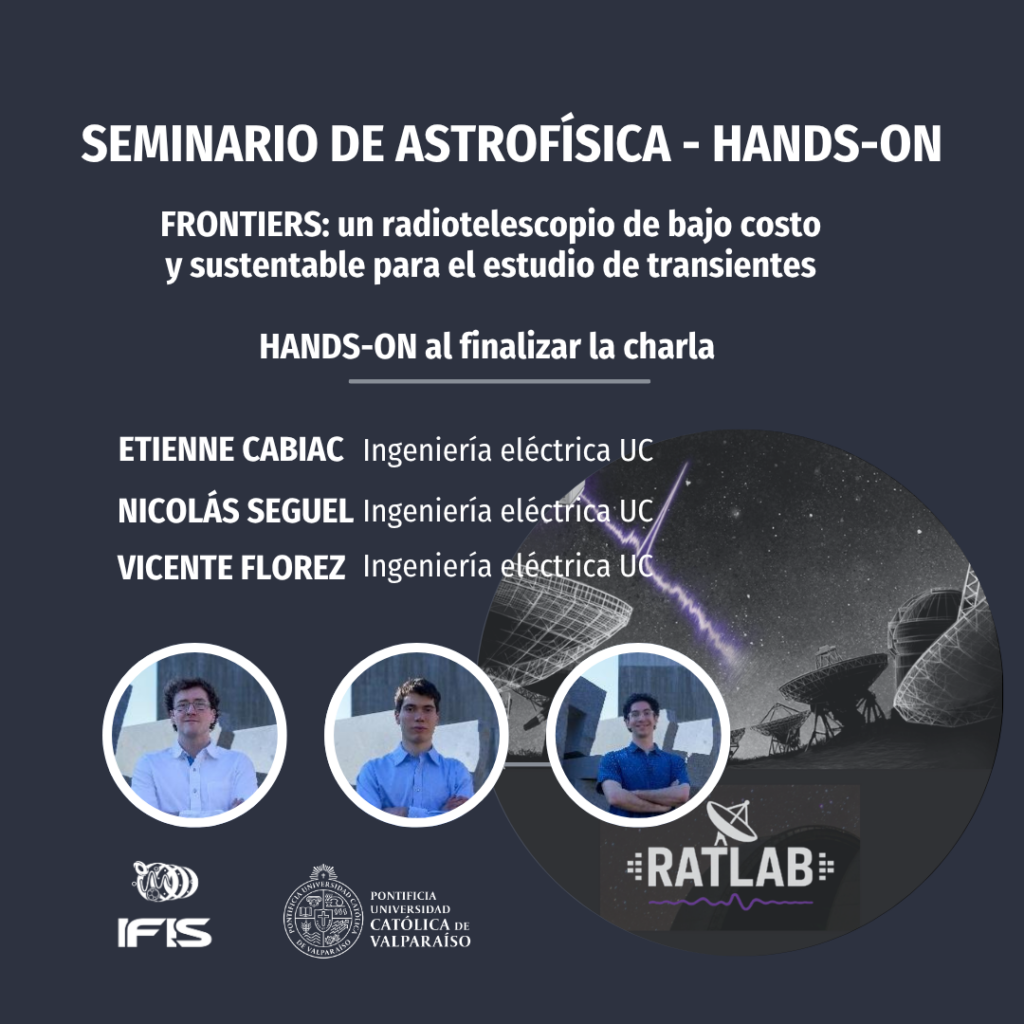
Seminario de Astrofísica: “FRONTIERS: un radiotelescopio de bajo costo y sustentable para el estudio de transientes”

Seminario de Astrofísica en el IFIS. El próximo martes 18 de noviembre a las 14:30 hrs, Etienne Cabiac, Nicolás Seguel y Vicente Florez, estudiantes de Ingeniería Eléctrica de la Universidad Católica, presentarán en el Instituto de Física el seminario:

“FRONTIERS: un radiotelescopio de bajo costo y sustentable para el estudio de transientes”.

La presentación se realizará en la Sala 208 del Instituto de Física (IFIS), 2° piso, Edificio de Ciencias, Campus Curauma, PUCV.

Revisa el abstract de la presentación:

La radioastronomía ha sido transformada por el rápido aumento en el descubrimiento de eventos transientes gracias a telescopios de última generación como FAST (China), MeerKAT (Sudáfrica) y CHIME (Canadá). Se espera que estas instalaciones descubran más de 10,000 nuevos pulsares y Fast Radio Bursts (FRBs) en los próximos cinco años, una cifra que difícilmente podrá ser monitoreada por las mismas. En este contexto, radiotelescopios más pequeños pero dedicados al monitoreo son esenciales para extraer el potencial científico de estas fuentes, como su uso como herramientas en cosmología en el caso de los FRBs o la detección de ondas gravitacionales mediante pulsares.

Presentamos FRONTIERS, un prototipo de arreglo compacto tipo Large N–Small D operando entre 1 y 2 GHz y alimentado mediante sistemas fotovoltaicos off-grid. En su etapa actual, FRONTIERS-pathfinder, se centra en los componentes clave de la cadena receptora de RF, con el objetivo de alcanzar una temperatura de sistema <50 K utilizando electrónica sin enfriamiento criogénico. El diseño integra manufactura aditiva, impresión 3D de feeds y backends digitales flexibles basados en placas de RF programables, lo que reduce el costo de arquitecturas clásicas de RF a menos de 15,000 USD por antena. Este proyecto es una colaboración entre el Centro de Astroingeniería UC y el Max Planck de Radioastronomía.

Además, al término del seminario se realizará un hands-on abierto a los estudiantes.


Compartimos el resumen del workshop:


Con el fin de determinar la interferencia electromagnética de la zona cercana a la universidad y, por tanto, si es viable colocar antenas en esa zona y qué bandas podemos estudiar, se utilizará un kit SDR.

Extendemos la invitación a la comunidad PUCV y al público interesado.

Seminario de Astrofísica: “The halo-galaxy connection through the lens of a machine: predicting galaxy clustering”

Seminario de Astrofísica en el IFIS. El próximo martes 4 de noviembre a las 14:30 hrs, Catalina Riveros, Licenciada en Astrofísica, Universidad Técnica Federico Santa María – USM, presentará el seminario:

“The halo-galaxy connection through the lens of a machine: predicting galaxy clustering”.

La presentación se realizará en la Sala 208 del Instituto de Física (IFIS), 2° piso, Edificio de Ciencias, Campus Curauma, PUCV.

Revisa el abstract de la presentación:

The large-scale linear bias encapsulates the relation between the clustering of galaxies and that of the underlying dark matter (DM) density field. A recently developed object-by-object estimator (b_inv) provides significant analytical advantages as compared to the traditional population-based methods. In this pioneering work, we employ the IllustrisTNG300 simulation, combining cutting-edge Machine Learning (ML) techniques to predict, for the first time, b_inv from DM halo and environmental properties. This framework offers a new perspective into the halo-galaxy connection. By evaluating multiple ML models, we demonstrate that deterministic methods fail to accurately reproduce this estimator, revealing the necessity of probabilistic models to capture the intrinsic stochasticity of b_inv—a critical insight given the nonlinear nature of galaxy and halo formation. Our analysis identifies the most relevant galaxy bias dependencies, and establishes a foundation for measuring individual bias in future galaxy surveys like DESI.

Extendemos la invitación a la comunidad PUCV y al público interesado.