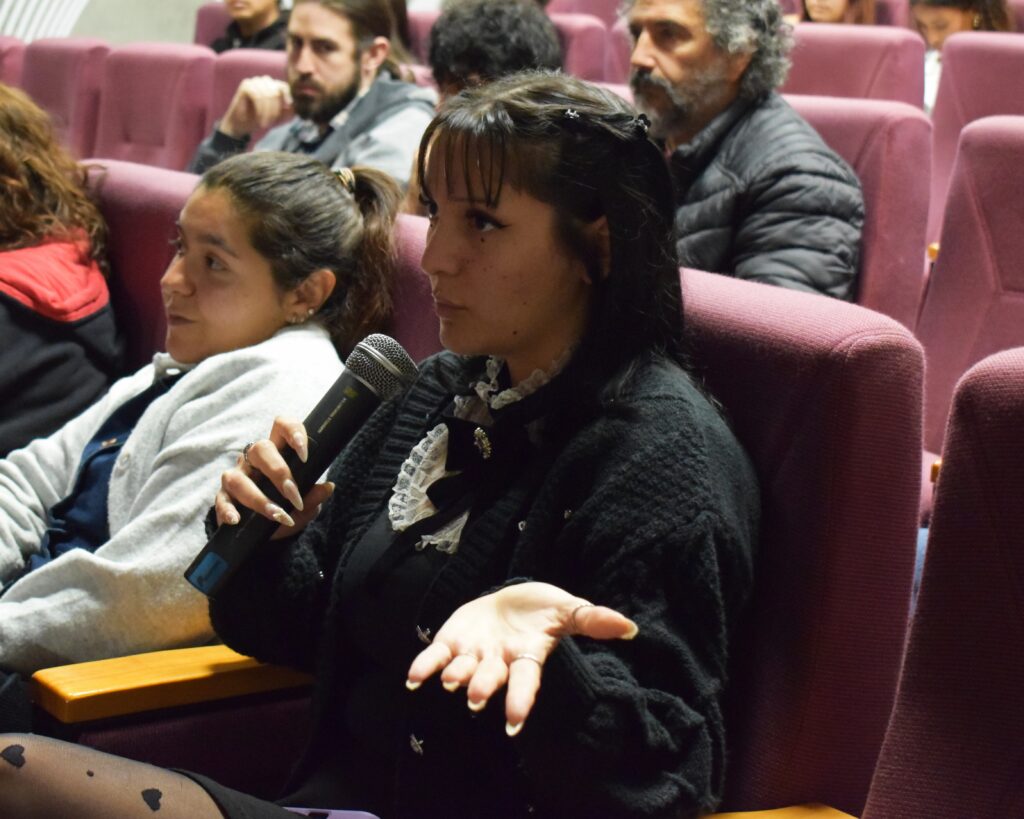
Seminario de Astrofísica: “FRBs as foreground probes: Recent results from the CHIME collaboration and ongoing work with FLIMFLAM”

Seminario de Astrofísica en el IFIS. Este martes 09 de junio a las 14:30 hrs, el Dr. Sunil Simha, investigador postdoctoral (Northwestern University and The University of Chicago), presentará en el Instituto de Física el seminario:

“FRBs as foreground probes: Recent results from the CHIME collaboration and ongoing work with FLIMFLAM”.

La presentación se realizará en la Sala 208 del Instituto de Física (IFIS), 2° piso, Edificio de Ciencias, Campus Curauma, PUCV.

Revisa el abstract de la presentación:

The field of Fast Radio Bursts (FRBs) is experiencing a rapid growth in FRB detections spearheaded by the CHIME/FRB collaboration. The CHIME Outrigger telescopes have come into full operation since early 2025 and have enabled sub-arcsecond-scale VLBI localizations of tens of published FRBs to date. Subsequently, our optical follow-up led by the F^4 team is steadily associating the bursts with their hosts and obtaining spectroscopic redshifts for these bursts. Armed with the FRB dispersion measures (DM) and their host redshifts, we are now able to constrain the gas distribution along the FRB sightlines. In my talk, I will provide an overview of our early results, including: (1) constraints on galactic feedback models prevalent in FRB hosts, (2) baryon retention fractions in group and cluster halos, (3) host galaxy ISM constraints from an extremely bright nearby (~40 Mpc) burst, and (4) a statistical hint of halo gas around M31. I will also highlight some of the ongoing work on the FLIMFLAM project, an effort to constrain gas in halos and the IGM via spectroscopic maps of foreground galaxies.

Extendemos la invitación a la comunidad PUCV y al público interesado.

Coloquio en el IFIS: “The Simons Observatory”

El próximo miércoles 10 de junio, la Dra. Jo Dunkley, cosmóloga y profesora Joseph Henry de Física y Ciencias Astrofísicas en la Universidad de Princeton, dictará el coloquio “The Simons Observatory” a las 11 horas en la Sala 208 del Instituto de Física, Edificio de Ciencias, Campus Curauma, PUCV.

Compartimos el resumen de la presentación:

The Simons Observatory (SO), a new millimeter-wave observatory in the Atacama, has started gathering data. It measures the cosmic microwave background (CMB), the earliest image we have of the universe, with the goal of better understanding our cosmological model. With its smaller telescopes we are seeking a primordial signal imprinted by gravitational waves generated in the early universe. Its largest telescope will measure the finer scales of the CMB with increased sensitivity, probing the initial conditions of the early universe as well as revealing the later-formed cosmic web of gas and dark matter.  By surveying half the sky every couple of days, we also hope to see new types of transient astronomical events in millimeter-wavelengths with SO. In this talk I will describe the status of SO and its science plans.

Extendemos la invitación a la comunidad del Instituto de Física y público interesado a participar de este coloquio.

Seminario de Astrofísica: “The JWST Emission Line Survey (JELS)”

Seminario de Astrofísica en el IFIS. El próximo martes 26 de mayo a las 14:30 hrs, el Dr. Eduardo Ibar, académico de la Universidad de Valparaíso, presentará en el Instituto de Física el seminario:

“The JWST Emission Line Survey (JELS)”.

La presentación se realizará en la Sala 208 del Instituto de Física (IFIS), 2° piso, Edificio de Ciencias, Campus Curauma, PUCV.

Revisa el abstract de la presentación:

The H-alpha (Ha) emission is the best-calibrated star-formation rate (SFR) tracer. Previous to JWST, surveys mapped the evolution of Ha emitters out to the peak of the Cosmic SFR Density (CSFRD) at z~2.5. Beyond this redshift, samples of star-forming galaxies and estimates of the CSFRD were almost ubiquitously based on rest-frame UV observations with HST. In this talk, we describe new JWST NIRCam’s narrow-band filters to observe a 65 arcmin^2 in COSMOS to identify several 100s of line-emitting galaxies. We consider difference imaging between closely-spaced narrow and broad band filters, to find line-emitting galaxies to provide the first clean and robust sample of homogeneously selected star-forming galaxies into the Epoch of Reionization (at z~6.2 and 8.2). We measure the ionised gas structures of these galaxies at sub-kpc resolution, determine how the relationship between UV and ionised gas varies with host galaxy properties, and tackle the physical processes driving the star formation activity at different reshifts. We describe also the properties of a newly discovered population of Paschen emitters at Cosmic Noon (Pa-alpha@z~1.5, Pa-beta@z~2.6) including their SED properties, their contribution to the CSFRD, and upcoming future follow-up campaigns.

Extendemos la invitación a la comunidad PUCV y al público interesado.

Coloquio en el IFIS: “From the Wavefunction of the Universe to In-In-Correlators: A Perturbative Map to All Orders”

El próximo miércoles 27 de mayo, el Dr. Gonzalo Palma, cosmólogo teórico y académico de la Universidad de Chile, dictará el coloquio “From the Wavefunction of the Universe to In-In-Correlators: A Perturbative Map to All Orders” a las 11 horas en la Sala 208 del Instituto de Física, Edificio de Ciencias, Campus Curauma, PUCV.

Compartimos el resumen de la presentación:

In this talk, I will review recent progress in the systematic computation of primordial correlation functions. These quantities are central theoretical tools for connecting models of the early universe with cosmological observations. Two complementary frameworks play a key role in this problem: the Wavefunction of the Universe approach and the Schwinger-Keldysh, or in-in, formalism. Both are designed to describe the same physical observables, but they organize computations in rather different ways. Although their conceptual equivalence has long been appreciated, the precise relation between their diagrammatic expansions has remained somewhat obscure. I will describe a recent construction that makes this relation explicit. The result provides a clearer understanding of how different perturbative approaches to primordial cosmology are connected, and offers a useful perspective on the structure of cosmological observables.

Extendemos la invitación a la comunidad del Instituto de Física y público interesado a participar de este coloquio.

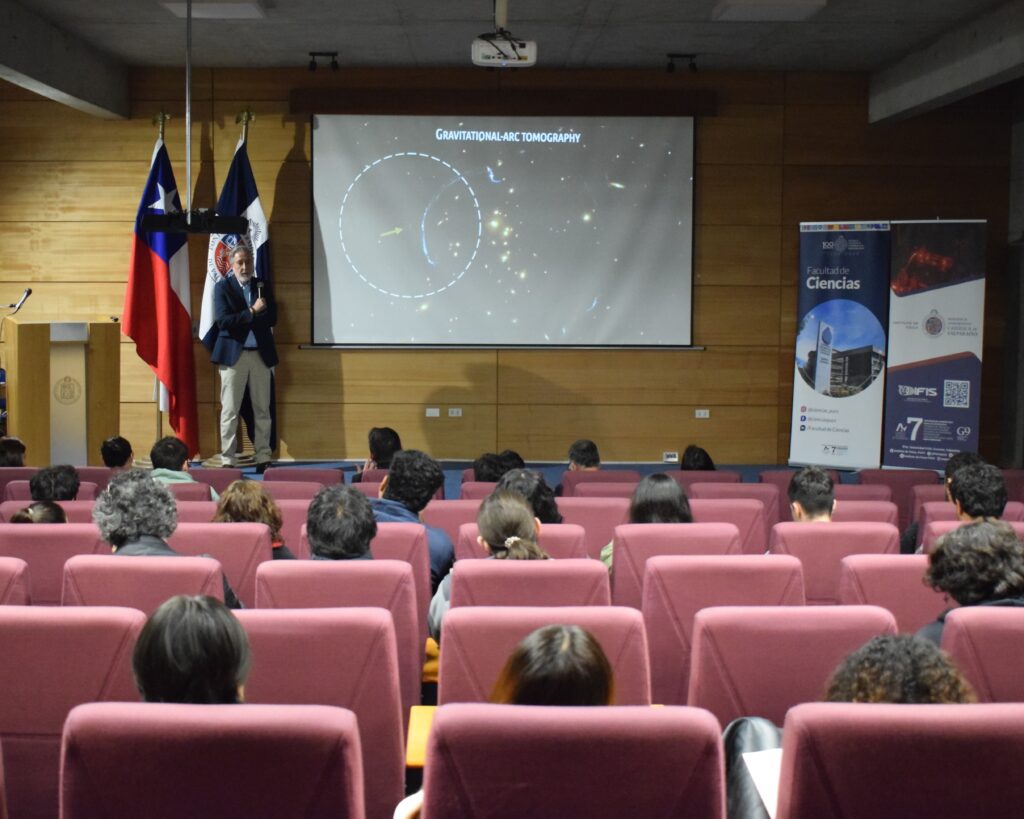
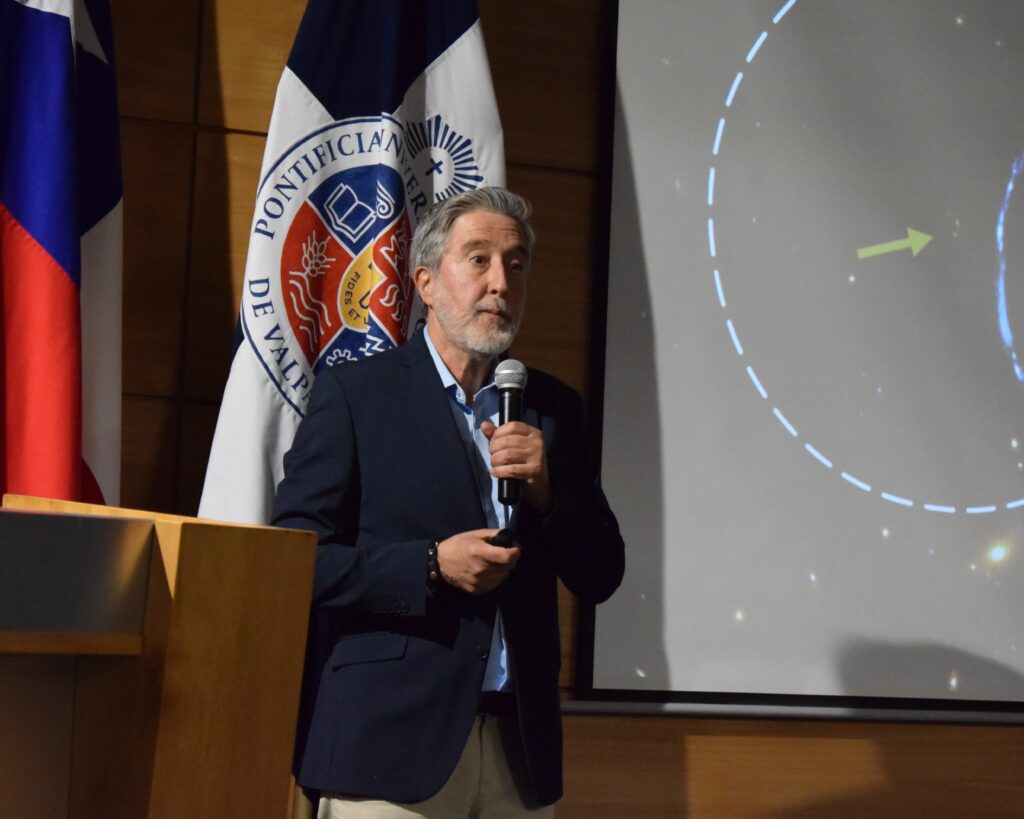
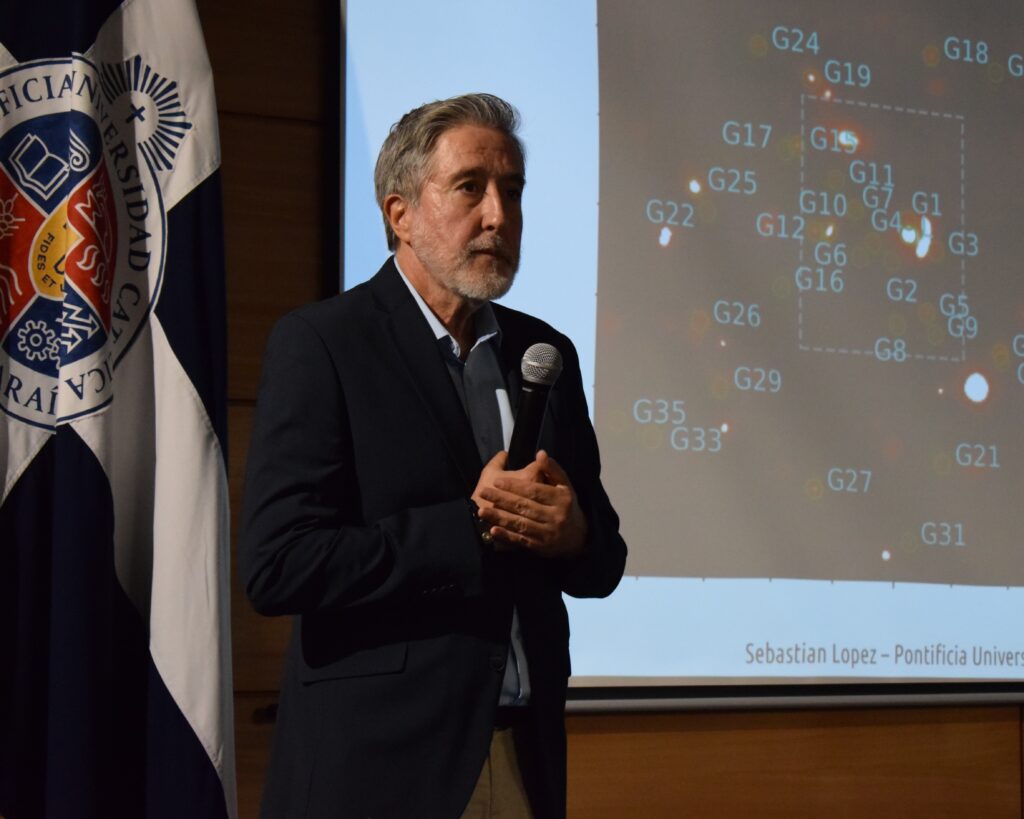
IFIS inaugura año académico con visita de astrónomo de la U. de Chile

El Dr. Sebastián López Morales presentó una ponencia basada en el proyecto “Tomography of the gaseous universe using gravitational lenses”, que trabaja en conjunto con Nicolás Tejos, profesor PUCV.

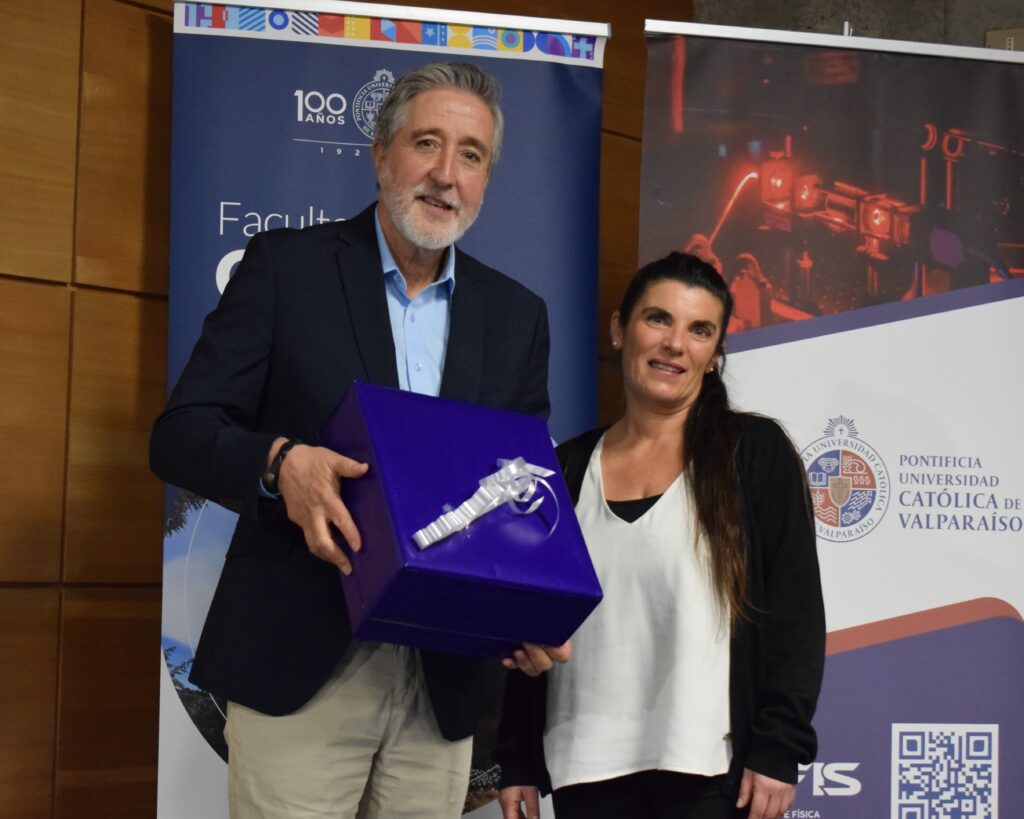
Este martes 28 de abril, se celebró la inauguración oficial del año académico del Instituto de Física PUCV, instancia que contó con la visita del Dr. Sebastián López Morales, astrónomo y profesor titular del Departamento de Astronomía de la Universidad de Chile. 

El invitado presentó la ponencia: What Matter(s) Around Galaxies?, basada en un proyecto que está llevando a cabo con el académico PUCV, Nicolás Tejos. El trabajo, titulado: “Tomography of the gaseous universe using gravitational lenses” o simplemente “TULIP” (tulipán), actualmente les está permitiendo dilucidar la estructura espacial y cinemática del material que rodea a las galaxias en varias épocas del universo.

“Creo que Chile es privilegiado en cuanto a la difusión de la Astronomía, lo que se debe al mero hecho de tener los telescopios en el norte. Eso ha llevado a lo largo de los años a un interés, especialmente de la juventud, en estudiar esta disciplina. Vemos en la U. de Chile y en la PUCV, que llegan cada vez más y mejores estudiantes a esta carrera”, afirmó el profesor, agregando que se siente honrado de haber sido invitado a dar una charla magistral.

“La inauguración del año académico nos da un punto de partida para que nos unamos todos, podamos conocer algo de ciencias y además darnos un saludo de comienzo para que todas nuestras actividades tengan un buen arranque”, comentó Mónica García, directora del IFIS.

Por último, la académica indicó que como Instituto están muy agradecidos del desarrollo de la actividad y de la visita del Dr. López. “Es un gran evento para nosotros”, concluyó.

Revisa algunas imágenes de la jornada:

Coloquio en el IFIS: “The Halos of Satellite Galaxies: Where Do Their Gas and Metals Go?”

El próximo miércoles 06 de mayo, la Dra. Sapna Mishra, académica del Space Telescope Science Institute (Baltimore, Maryland, USA), dictará el coloquio “The Halos of Satellite Galaxies: Where Do Their Gas and Metals Go?” a las 11 horas en la Sala 208 del Instituto de Física, Edificio de Ciencias, Campus Curauma, PUCV.

Compartimos el resumen de la presentación:

Satellite galaxies play a key role in the chemical evolution of the universe by redistributing gas and metals across halo environments. Their interactions with massive hosts through tidal and ram-pressure stripping regulate both their star-formation histories and the metal budget of their circumgalactic media (CGM). Yet, the diffuse CGM of satellite galaxies remains largely unexplored observationally. The Large Magellanic Cloud (LMC) provides the only well-characterized case to date. Our recent UV absorption-line studies with Hubble Space Telescope (HST) toward 28 background quasars reveal that the LMC’s metal-enriched CGM is truncated to one-tenth of its virial radius, consistent with ram-pressure stripping by the Milky Way’s hot corona. This provides a rare, direct view of how environmental forces remove or redistribute metals in low-mass galaxies. However, future UV observations are needed to explore how typical the MW-LMC interaction is, and how satellites retain their gas and metals? This presentation will highlight how HST will uniquely trace metals in other satellite CGMs across the Local Group and beyond.

Extendemos la invitación a la comunidad del Instituto de Física y público interesado a participar de este coloquio.

Seminario de Astrofísica: “From Local Galaxies to Cosmic Noon: Non-Parametric Morphology Across Cosmic Time”

Seminario de Astrofísica en el IFIS. El próximo martes 05 de mayo a las 14:30 hrs, el Dr. Vitor Sampaio, investigador postdoctoral de la Universidad Técnica Federico Santa María, presentará en el Instituto de Física el seminario:

“From Local Galaxies to Cosmic Noon: Non-Parametric Morphology Across Cosmic Time”.

La presentación se realizará en la Sala 208 del Instituto de Física (IFIS), 2° piso, Edificio de Ciencias, Campus Curauma, PUCV.

Revisa el abstract de la presentación:

Galaxy morphology is a fundamental probe of galaxy evolution, providing insight into the physical mechanisms that shape galaxies across cosmic time, including mergers, secular processes, star formation, and quenching. A wide range of approaches has been developed to quantify and classify morphology, from visual inspection and citizen-science efforts to parametric modeling, non-parametric structural indexes, and machine/deep learning techniques. Focusing on the use of non-parametric morphological indexes, we test its reliability as a robust and reproducible framework for galaxy classification. The method is first tested in the local Universe, where its performance is assessed through comparison with Galaxy Zoo 1 visual classifications. Once validated at low redshift, the approach is extended to higher redshifts using CANDELS observations, enabling the classification of galaxies over the range 0.2<z<2.4. These classifications provide a basis for studying the cosmological evolution of disk- and bulge-dominated galaxies, revealing how the relative abundance of different structural populations changes with redshift. The analysis also identifies two distinct families of bulge-dominated galaxies, suggesting multiple evolutionary pathways for the formation and assembly of spheroidal systems. Finally, the results motivate future extensions of this framework to even higher redshifts with JWST, where improved depth and spatial resolution will allow galaxy structure to be explored during earlier stages of cosmic history.

Extendemos la invitación a la comunidad PUCV y al público interesado.