Coloquio en el IFIS: “Space Metamorphosis”

El próximo miércoles 26 de noviembre, Sumit Ranjan Das, académico de la University of Kentucky (EE. UU.) y reconocido investigador en teoría cuántica de campos y teoría de cuerdas, dictará el coloquio “Space Metamorphosis” a las 11:00 horas en la Sala 208 del Instituto de Física, Edificio de Ciencias, Campus Curauma, PUCV.

Compartimos el resumen de la presentación:

Current ideas about quantum gravity often involve scenarios where notions of space-time are not fundamental: rather they are emergent, approximate descriptions of more fundamental structures. One class of such ideas involves metamorphosis of internal degrees of freedom into physical space dimensions. This talk traces the conceptual origins of these ideas in the theory of strong interactions, their evolution into descriptions of quantum gravity and their connection to quantum entanglement.  We will discuss some recent attempts to understand entanglement of internal degrees of freedom and its relevance to the question of locality.

Reseña personal:

Es reconocido por su descubrimiento del comportamiento de escala universal en enfriamientos rápidos dentro de teorías de campo cuántico, así como por sus contribuciones fundamentales al desarrollo de modelos de matrices como descripciones de la teoría de cuerdas no perturbativa.
Recibió el Premio Bhatnagar, el más alto reconocimiento científico de la India, en 1998, y fue elegido miembro de la Academia India de Ciencias en 1997.

Extendemos la invitación a la comunidad del Instituto de Física y público interesado a participar de este coloquio.


Coloquio en el IFIS: “Energy correlators and Asymptotic Symmetries”

El próximo miércoles 5 de noviembre, Hernán González Leiva, licenciado en Física y académico de la Universidad San Sebastián de Santiago, dictará el coloquio “Energy correlators and Asymptotic Symmetries” a las 11a las 11:00 horas en la Sala 208 del Instituto de Física, Campus Curauma, PUCV.

Compartimos el resumen de la presentación:

Scattering processes in gauge theory and gravity always produce radiation that travels out to null infinity. Energy correlators provide a natural way to describe what is actually measured there: they track how energy is distributed on the celestial sphere and define infrared-safe observables. I will explain how these observables relate to soft radiation and asymptotic symmetries, and how they form the basis of the celestial holography program. The emphasis will be on physical ideas rather than technical details.

Extendemos la invitación a la comunidad del Instituto de Física y público interesado a participar de este coloquio.
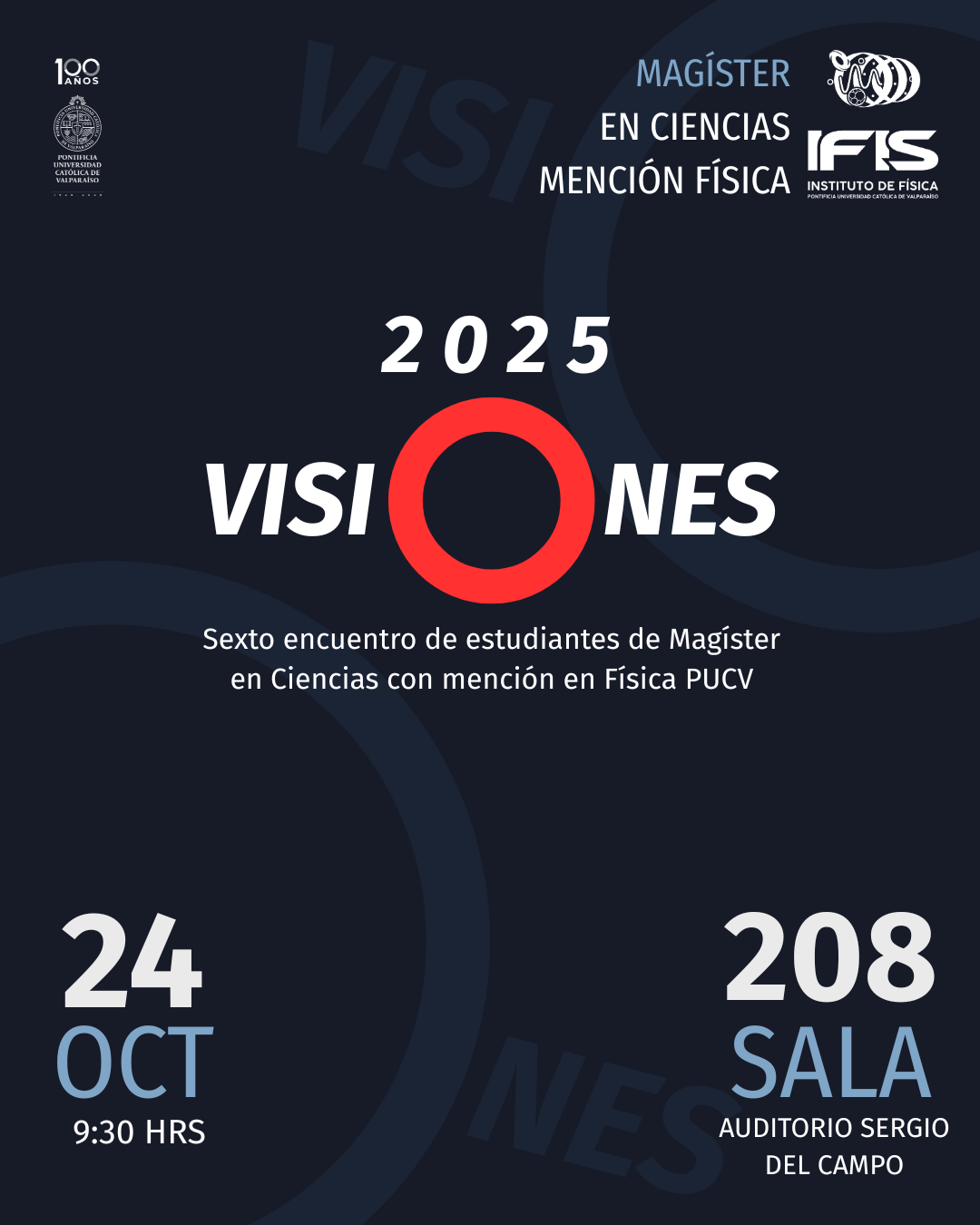
¡Se acerca VISIONES 2025!

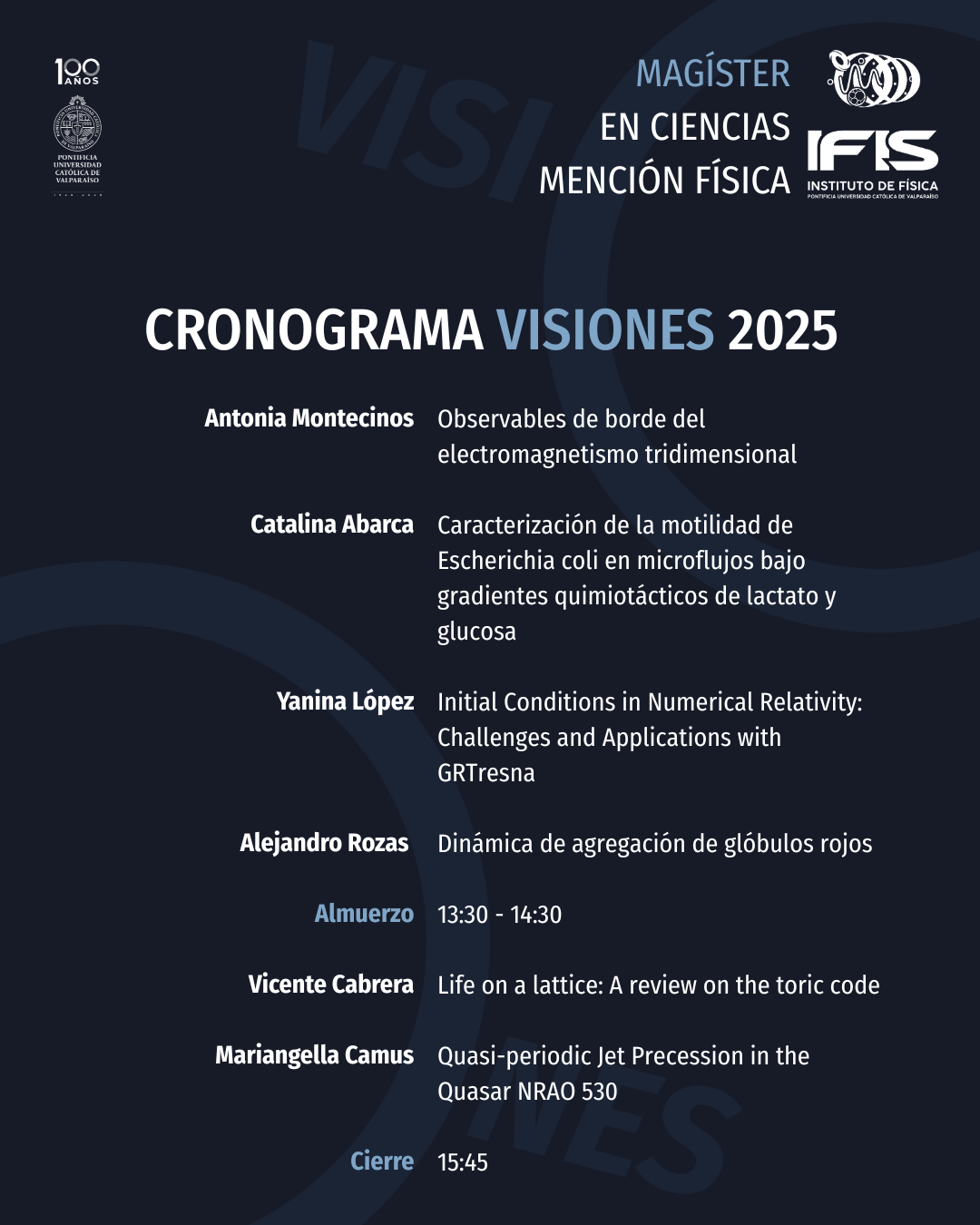
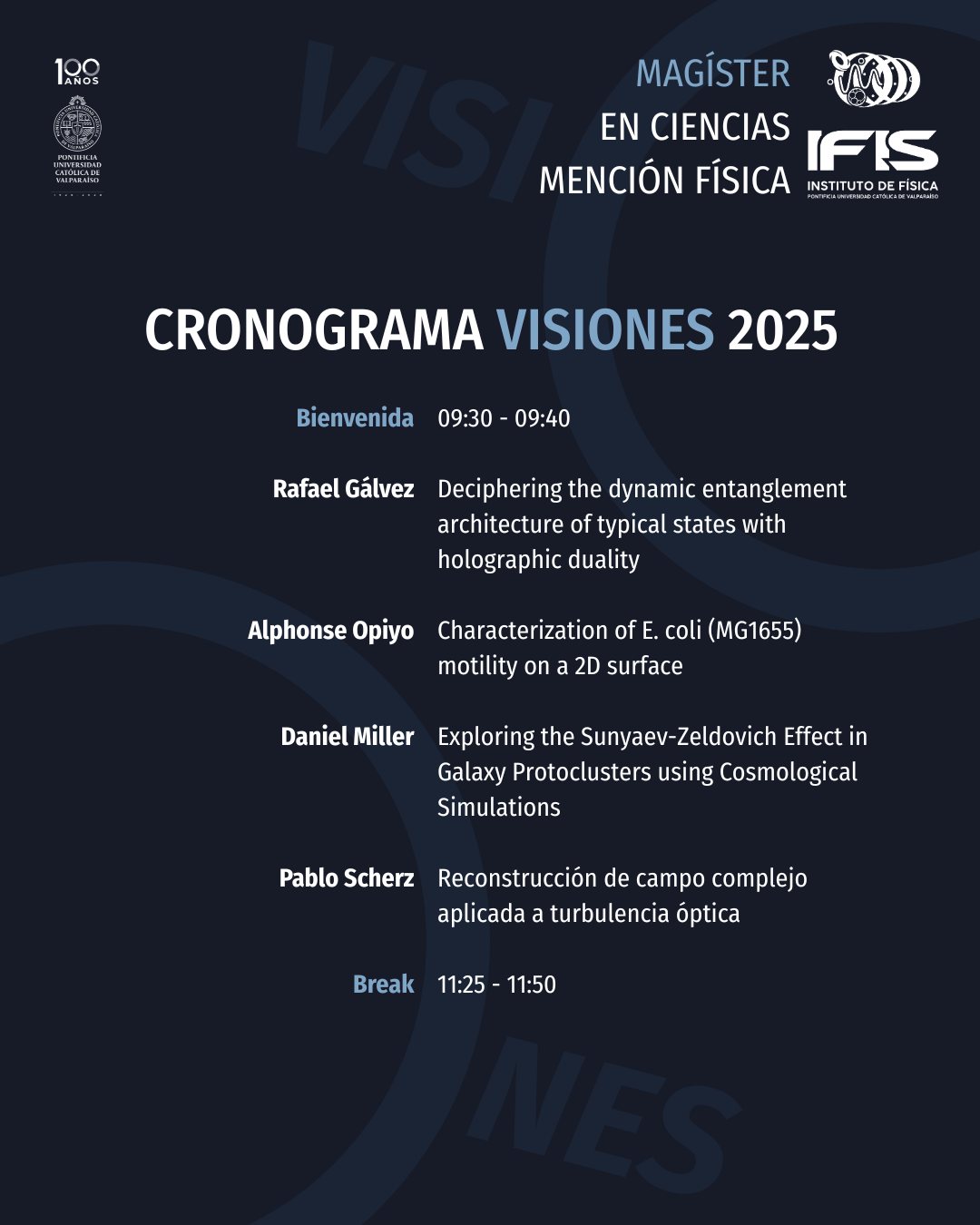
El evento “Visiones 2025” se realizará este viernes 24 de octubre desde las 09:30 hrs en la Sala 208 (Auditorio Sergio del Campo) del Instituto de Física PUCV. Esta actividad es una plataforma única para que las y los estudiantes del Programa de Magíster en Ciencias con mención en Física presenten sus avances y resultados de sus investigaciones.

Para esta edición, no solo destaca la dedicación y el compromiso de los futuros científicos, sino que también se invita a la comunidad académica a profundizar en diversas áreas de estudio que reflejan la amplitud y el dinamismo del campo de la física.

Revisa toda la información aquí:

Seminario de Astrofísica: “Searching for Gravitationally Lensed Quasars using Machine Learning on Light Curves from the Zwicky Transient Facility”

Seminario de Astrofísica en el IFIS. El próximo martes 21 de octubre, Catalina Saez, licenciada en astronomía de la Universidad de Valparaíso, presentará “Searching for Gravitationally Lensed Quasars using Machine Learning on Light Curves from the Zwicky Transient Facility”, desde las 14:30 hrs en la Sala 208 del Instituto de Física PUCV.

Revisa el abstract de la presentación:

Strong gravitational lensing of quasars (QSOs) provides valuable insights into galaxy evolution, cosmology, and the geometry of the Universe. With the advent of the Legacy Survey of Space and Time (LSST), expected to discover over 8,000 new lensed QSOs, scalable and automated identification methods are increasingly necessary. In this work, we propose a novel approach that integrates temporal variability from Zwicky Transient Facility Data Release 5 (ZTF DR5) light curves into the search for lensed QSOs. Building upon Sánchez-Sáez et al. (2021), we use latent features from a Variational Recurrent Autoencoder (VRAE) and variability features from the ALeRCE broker to train a Balanced Random Forest (BRF) classifier on a clean sample of 23,876 spectroscopically confirmed lensed QSOs, including 52 confirmed lenses from the Strong Lensing Database (SLED). The best model recovered all known lenses and, with a probability threshold of 0.75, identified 59 high-probability candidates. After visual inspection, 12 new promising candidates were found. Despite some misclassifications, our results highlight the potential of incorporating light-curve variability for efficient lens discovery. Future spectroscopic follow-up will be crucial to confirm these candidates and refine the model.

Extendemos la invitación a la comunidad PUCV y al público interesado.

Olimpiada Chilena de Física 2025 – Convocatoria Regional PUCV

La Sociedad Chilena de Física y el Instituto de Física PUCV invitan a establecimientos de la Región de Valparaíso a participar en la Olimpiada Chilena de Física 2025. La Etapa Regional se realizará en Campus Curauma, PUCV, y seleccionará a las y los representantes de la región para la Final Nacional.


¿Quiénes pueden participar?

  • Estudiantes de 3° y 4° Medio.

  • Cada establecimiento puede inscribir hasta 6 estudiantes.

  • Inscripción gratuita (cupos limitados por orden de inscripción).

Fechas clave (Etapa Regional – PUCV)

  • Cierre de inscripciones: jueves 25 de septiembre.

  • Jornada regional: jueves 02 de octubre, 10:00 a 14:30 h

    • Prueba teórica · Charla científica · Visita a laboratorios (Campus Curauma).

  • Publicación de resultados: viernes 17 de octubre.

Inscripción

Enviar la ficha de inscripción (una por establecimiento) al correo indicado en las bases hasta el 25 de septiembre.

Es importante completar todos los datos solicitados, incluido el correo de cada estudiante, para la posterior gestión de consentimientos informados.

Institución organizadora (sede regional): Instituto de Física PUCV
Coordinador regional: Prof. Rodrigo Rivera


DESCARGA AQUÍ LAS BASES:

Coloquio en el IFIS: “Turbulencia y fluidos complejos: un viaje no lineal desde flujos de Couette hasta el sistema cardiovascular”

El próximo miércoles 20 de agosto, Juan Francisco Marín Medina, académico de la Universidad Tecnológica Metropolitana, dictará el coloquio “Turbulencia y fluidos complejos: un viaje no lineal desde flujos de Couette hasta el sistema cardiovascular” a las 11:00 horas en la Sala 208 del Instituto de Física, Campus Curauma, PUCV.

Compartimos el resumen de la presentación:

La turbulencia en flujos bajo cizalle y en fluidos complejos biológicos comparten mecanismos no lineales que trascienden la escala y el contexto físico. En la primera parte de este coloquio exploraré el uso de modelos estocásticos unidimensionales de reacción-advección-difusión para describir la transición subcrítica a la turbulencia en flujos de Couette. En estos sistemas, la turbulencia homogénea y el flujo laminar coexisten, conectándose por medio de estructuras coherentes no lineales como patrones de Turing y pulsos localizados. En la segunda parte, trasladaré estas ideas al sistema cardiovascular, donde válvulas coronarias artificiales pueden inducir estructuras turbulentas dañinas en la aorta ascendente. Con el objetivo de controlar estos flujos turbulentos, exploraremos  modelos teóricos en desarrollo que consideran procesos autosostenidos de turbulencia en la aorta y su interacción con ondas de presión sanguínea tipo solitón. Esta aproximación conecta la física no lineal con aplicaciones biomédicas, abriendo perspectivas para el diseño de estrategias activas de mitigación de turbulencia en pacientes con válvulas coronarias mecánicas.

Extendemos la invitación a la comunidad del Instituto de Física y público interesado a participar de este coloquio.
Seminario de Astrofísica: “Dissecting the CGM: observational insights into the origin of PDLAs and simulated Arc-Tomography in TNG50”

El próximo martes 1 de julio, Francisco Urbina, de la Universidad de Chile, dictará el seminario “Dissecting the CGM: observational insights into the origin of PDLAs and simulated Arc-Tomography in TNG50” a las 11:00 horas en la Sala 208 del Instituto de Física, Campus Curauma, PUCV.

Compartimos el resumen de la presentación:

The gas reservoirs of galaxies and their interactions regulate galaxy evolution in a set of processes known as the baryon cycle. The venue where all these gas flows occur is known as the circumgalactic medium (CGM). Due to its diffuse nature, the CGM has been historically studied by means of QSO absorption spectra, providing only one line of sight per galaxy. This paradigm has radically changed in the last decade, where Integral Field Spectrographs in 8-10m class telescopes have been able to map the CGM both in emission, utilizing strong emission lines like Lyα, and in absorption, using giant gravitational arcs as background sources (technique known as gravitational-arc tomography). Taking advantage of this new transverse exploration of the diffuse gaseous environments of galaxies, the talk will focus on two fronts: first, using a compilation of PDLA-selected-QSOs observed with VLT/MUSE, characterize both the extended and compact Lyα emission, in order to constrain the origin of PDLAs and, thanks to the natural coronagraph offered by these proximate absorbers, to explore the inner regions of Lyα nebulae, offering some hints into the powering mechanism of Lyα nebulae. Second, utilizing TNG50 cosmological simulations, produce mock IFS-like absorption spectra to directly compare with the gravitational-arc tomography observations, studying the effect different spatial samplings have on different observables, comparing QSO and arc-tomography statistics, and computing the TNG50 cool CGM coherence length. 

Extendemos la invitación a la comunidad del Instituto de Física y público interesado a participar de este seminario.

Primera Luz del Observatorio Vera C. Rubin se transmitirá desde la PUCV

Este lunes 23 de junio a las 11:00 horas, se llevará a cabo una actividad especial en la Sala de Astronomía del Edificio de Ciencias (cuarto piso) de la Pontificia Universidad Católica de Valparaíso, con motivo de la transmisión en vivo de la Primera Luz del Observatorio Vera C. Rubin.

Ubicado en el cerro Pachón, Región de Coquimbo, Rubin contiene uno de los telescopios más avanzados del mundo y tiene como objetivo realizar el LSST (Legacy Survey of Space and Time), tomando fotografías de la totalidad del cielo nocturno del hemisferio sur durante 10 años, creando el video más largo del universo.

Este observatorio tiene 4 objetivos principales:

  • La comprensión de la materia oscura
  • Catalogar el sistema solar
  • Cartografiar la Vía Láctea
  • Estudiar eventos transitorios como supernovas

La actividad marcará el comienzo de una nueva era para la astronomía y representa una oportunidad única para la comunidad científica chilena, que contará con acceso privilegiado a los datos generados por este ambicioso proyecto.

Extendemos la invitación a la comunidad del Instituto de Física y al público interesado a participar de este evento.

Encuentra más información en: 

https://rubinobservatory.org/es

Seminario de Astrofísica: “Joint Constraints on the Richness–Mass Scaling Relationship and Electron Pressure Profiles of Galaxy Clusters”

El próximo martes 26 de agosto, a las 14:30 horas, Javier Urrutia, máster en Física PUCV, dictará el seminario “Joint Constraints on the Richness–Mass Scaling Relationship and Electron Pressure Profiles of Galaxy Clusters” en la Sala 208 del Instituto de Física, Campus Curauma, PUCV.

Compartimos el resumen de la presentación:

Galaxy clusters are one of the most important cosmological probes in the Universe. These correspond to the largest and most massive gravitationally bound objects and they give rise to a variety of gravitational and non-gravitational phenomena. One of the most important property of clusters is their mass, which is highly useful in cosmology. Unfortunately, most of the clusters’ matter content is dark matter. Therefore, it is useful to calibrate cluster mass using other relatively accessible properties. These relationships are called scaling relations. The richness-mass relationship is a well-known example of these with low scatter, which relates the total mass content of a cluster with how many red galaxies it contains.

On the other hand, the baryonic content in galaxy clusters, mainly located in the Intra-Cluster Medium (ICM), provides additional information. Unfortunately, baryons can be affected by non-gravitational physical processes. One powerful way of studying the ICM is the Thermal Sunyaev-Zel’dovich Effect, a spectral distortion induced in the Cosmic Microwave Background (CMB) produced by inverse Compton scattering between photons in the latter and electrons in the ICM. CMB photons can be also deflected by the presence of mass, an effect called CMB lensing. This means that combining both distortions makes it possible to access simultaneously the thermodynamical and gravitational state of clusters.

On this talk, we present a new richness-mass relationship, and a universal mass and electron pressure profile obtained by combining the latest data release from the Atacama Cosmology Telescope (ACT), which provides CMB Comptonization and lensing maps, with a cluster catalog obtained by applying the RedMaPPer algorithm to Dark Energy Survey (DES) Y3 data. This results are not only going to provide a new celibration but also will shed light on the radial distribution of hot gas and dark matter in a large cluster sample as a function of richness and redshift.

Extendemos la invitación a la comunidad del Instituto de Física y al público interesado a participar de este seminario.

Coloquio en el IFIS: “The Universe in Pixels: Precision Astrophysics with the Legacy Survey of Space and Time (LSST)”

El próximo miércoles 18 de junio, Alex Broughton, investigador del Kavli Institute for Particle Astrophysics and Cosmology (Stanford University), dictará el coloquio “The Universe in Pixels: Precision Astrophysics with the Legacy Survey of Space and Time (LSST)” a las 11:00 horas en la Sala 208 del Instituto de Física, Campus Curauma, PUCV.

Compartimos el resumen de la presentación:

The Legacy Survey of Space and Time (LSST) at the Vera C. Rubin Observatory will be a turning point for astronomy when it begins its decadal survey this year. The survey will cover 18,000 deg2 of the sky every three nights across 6 filters (ugrizy), generating 15TB of data every night using the largest digital camera in the world for astronomy (3,200 Mpx), and it will automatically grant data rights to all scientists and students affiliated with institutions in both the US and Chile. The survey will facilitate new institutional collaborations and groundbreaking research into dark energy and dark matter, galaxy evolution, the Milky Way, the solar system, and the transient optical sky. All LSST science will begin with pixel-level images, which contain artifacts such as traps, coffee stains, tree rings, and brighter-fatter that can mimic real astrophysical observables and need to be exquisitely controlled by state-of-the art image processing algorithms. In this talk, I will dive into the world of instrument signature removal (ISR) and discuss how different artifacts can impact photometry, centroid, and point-spread function (PSF) estimation and how we can use the Forward Global Calibration Method (FGCM) to correct some of these features across the LSST camera’s focal plane to achieve the photometric precision needed for LSST science (O(1) mmag). With these results, we will then look ahead at the scientific potential of the LSST era and the future of astrophysical discovery.

Extendemos la invitación a la comunidad del Instituto de Física y público interesado a participar de este coloquio.