
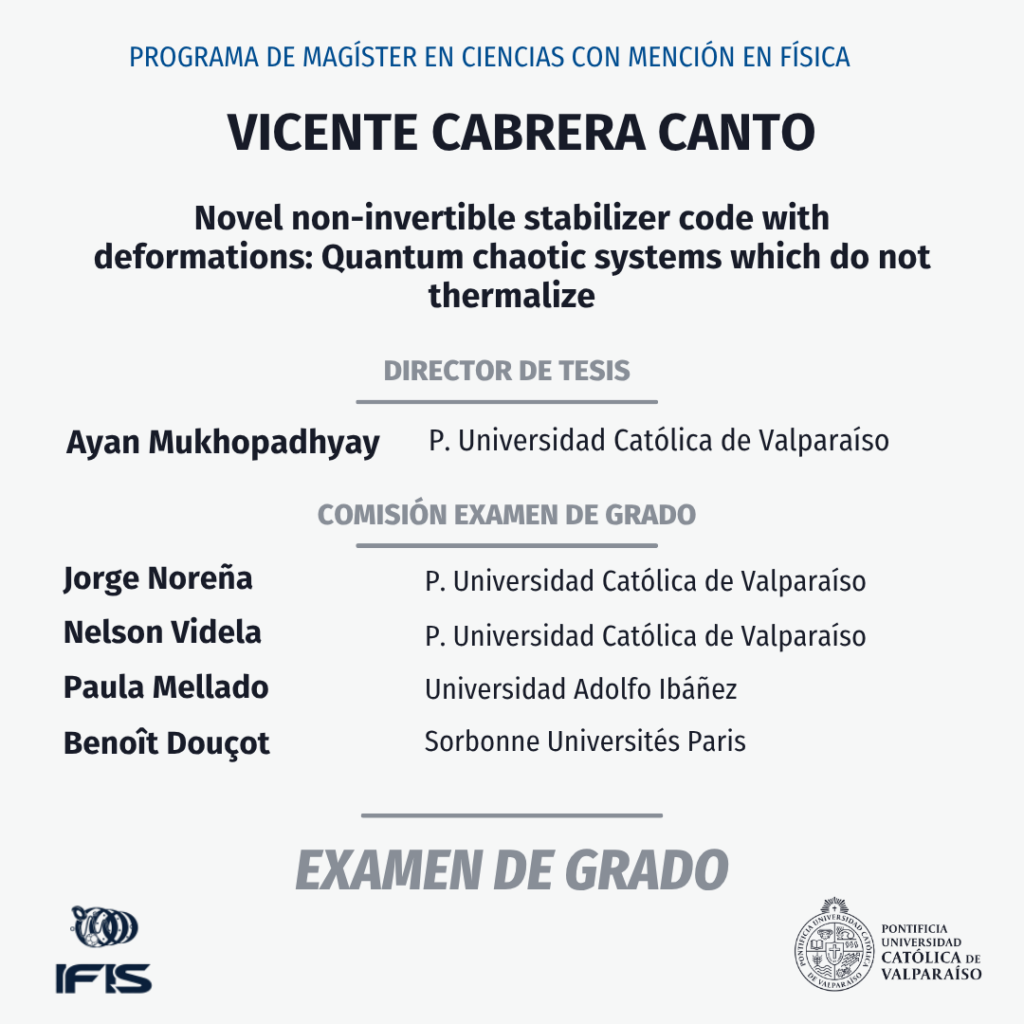
Examen de grado de magíster: Vicente Cabrera Canto defenderá su tesis “Novel non-invertible stabilizer code with deformations: Quantum chaotic systems which do not thermalize” este viernes 21 de agosto a las 11:00 AM en la Sala 208 de la Facultad de Ciencias PUCV.
La comisión será integrada por los académicos Paula Mellado de la Universidad Adolfo Ibáñez y Benoît Douçot (Sorbonne Universités Paris) junto a Jorge Noreña, Nelson Videla y Ayan Mukhopadhyay del IFIS PUCV.
Te dejamos el resumen de la tesis:
This work investigates a candidate approach for fault-tolerant quantum computing: the toric code proposed by Kitaev, a system featuring qubits on the edges of the spatial lattice. Aiming to generate potential new models for future technologies, we generalize the qubits to qutrits on the lattice and introduce non-invertible operators acting on the local Hilbert space. We define the excitations present in the system and study the non-Abelian and non-commutative fusion rules of the fractonic excitations. We extend the toric code’s stabilizer code structure to a stabilizer monoid. The problem is simplified by reducing the geometry of the torus to a ring with 2 rows and L columns; we then study the confined fractonic excitations in this simplified model using the Paige-Tarjan algorithm and the coarsest lumpable partitions. To characterize the statistical profile, we employ level-spacing statistics and tests of the Eigenstate Thermalization Hypothesis (ETH). Our model tends toward a spectral statistics compatible with the Gaussian Orthogonal Ensemble (GOE), with ⟨r⟩ ∼ 0.5307, a value typically linked to random matrix theory. We observe a partial violation of the Eigenstate Thermalization Hypothesis for two different values of L, a hypothesis that usually holds in the GOE regime. The results reveal GOE-like spectral statistics together with strong finite-size deviations from diagonal ETH in the studied observables. Determining whether these deviations persist in the thermodynamic limit will require larger system sizes and a systematic finite-size scaling analysis.