
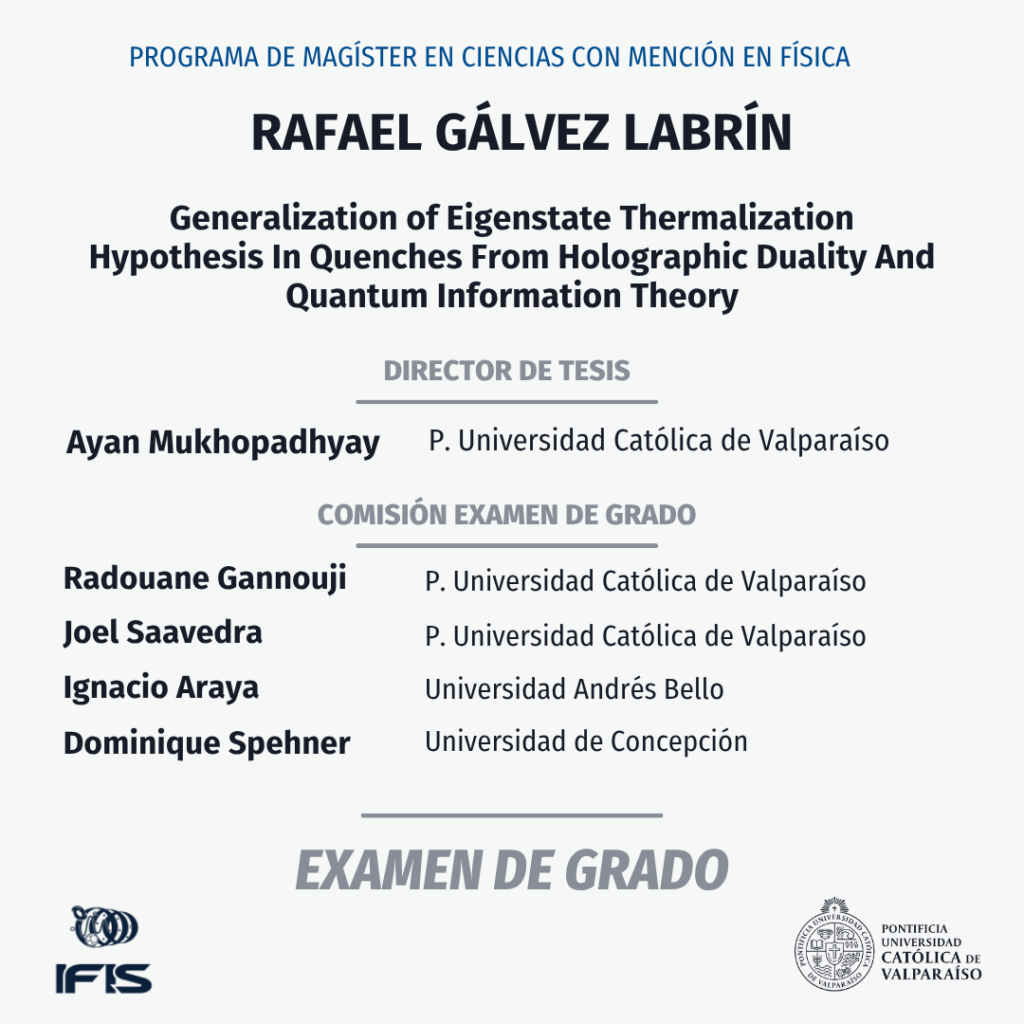
Examen de grado de magíster: Rafael Gálvez Labrín defenderá su tesis “Generalization of Eigenstate Thermalization Hypothesis In Quenches From Holographic Duality And Quantum Information Theory” este jueves 20 de agosto a las 1:00 PM en la Sala 208 de la Facultad de Ciencias PUCV.
La comisión será integrada por los académicos Ignacio Araya de la Universidad Andrés Bello, Dominique Spehner de la Universidad de Concepción junto a Ayan Mukhopadhyay, Radouane Gannouji y Joel Saavedra del IFIS PUCV.
Te dejamos el resumen de la tesis:
The Eigenstate Thermalization Hypothesis (ETH) states that individual high-energy eigenstates of chaotic quantum systems already encode thermal expectation values for sufficiently simple observables — but which observables qualify has never been specified sharply. In two-dimensional holographic conformal field theories at large central charge, the entanglement architecture of typical microstates makes that class explicit and geometric: every operator smeared over a scale below the factorization length LUV satisfies ETH, with deviations of order e^(−S<) controlled by the entropy of the minority chiral sector rather than by the full Bekenstein–Hawking entropy. The statement holds only while the quantum correlation scale LQC stays below LUV, and the margin of that condition is itself the suppression factor — so the criterion of validity and the measure of typicality are the same geometric quantity.
This thesis extends the result to global quantum quenches on Bañados–Vaidya shock geometries. Both scales contract at the quench onset and relax on separated timescales, so the class of ETH-satisfying operators shrinks discontinuously and re-expands: the architecture equilibrates hierarchically rather than as a rigid whole. Beyond a rotation-dependent temperature threshold, the architecture is not destroyed but migrates into a multipartite regime.