Smart Adaptive Optics for Quantum and Classical Communications through the Atmosphere
Capítulo IChapter I
Pérez y yoPérez and I
quién soywho I amRecibí mi grado de Doctor en Física en la Universidad Nacional de La Plata (2003). Llegué a la Pontificia Universidad Católica de Valparaíso en agosto de 2004. En el 2008 accedí a la jerarquía de Profesor Adjunto de este Instituto de Física, y luego en 2014 a la de Profesor Titular.
Desde mi llegada a Valparaíso he ganado diversos proyectos de investigación, fundado el Laboratorio de Óptica Atmosférica y Estadística (Atmospheric and Statistical Optics Laboratory, @SOL), y recientemente estoy a cargo de la Estación Óptica Terrestre (SEETRUE).
En este tiempo he publicado 76 trabajos científicos: 54 artículos en revistas indexadas y 22 en congresos internacionales. La universidad me ha reconocido con el Premio Excelencia en Investigación 2012 por ser uno de los científicos más productivos de la PUCV. Formo parte de dos claustros de doctorado: el Doctorado en Ciencias Físicas (consorcio PUCV-UTFSM) y el Doctorado en Ingeniería Eléctrica (PUCV).
Como académico siempre he estado comprometido con mi Universidad en diferentes lugares de gestión —Director del Instituto de Física, Director de Postgrado, Jefe de Carrera y Secretario Académico. En todas las oportunidades que he tenido no he dejado de escribir sobre qué, cómo y porqué hacemos academia…
I received my doctorate in Physics from the Universidad Nacional de La Plata (2003). I arrived at the Pontificia Universidad Católica de Valparaíso in August 2004. In 2008 I became Associate Professor at this Institute of Physics, and in 2014 Full Professor.
Since coming to Valparaíso I have won a number of research grants and founded the Atmospheric and Statistical Optics Laboratory (Laboratorio de Óptica Atmosférica y Estadística, @SOL), and I am now in charge of the SEETRUE Optical Ground Station.
Over these years I have published 76 scientific works: 54 articles in indexed journals and 22 in international conferences. The university awarded me its Research Excellence Prize in 2012 as one of the most productive scientists at PUCV. I belong to two doctoral faculties: the Doctorate in Physical Sciences (PUCV-UTFSM consortium) and the Doctorate in Electrical Engineering (PUCV).
As an academic I have always served my University in different administrative roles —Director of the Institute of Physics, Director of Graduate Studies, Head of Programme and Academic Secretary. Throughout, I have kept writing about what, how and why we do academia…
Capítulo IIChapter II
Los conjuradosThe Conspirators
el laboratoriothe laboratoryEl Laboratorio de Óptica Atmosférica y Estadística (@SOL) del Instituto de Física de la PUCV estudia cómo la atmósfera turbulenta transforma la luz que la atraviesa, y cómo medir esa turbulencia. Es el único laboratorio de óptica atmosférica de Latinoamérica. Combinamos teoría y experimento: generamos turbulencia controlada en el laboratorio, reconstruimos campos ópticos complejos a alta velocidad y medimos la atmósfera real desde nuestra propia estación óptica terrestre.
The Atmospheric and Statistical Optics Laboratory (@SOL) at the PUCV Institute of Physics studies how the turbulent atmosphere transforms the light that crosses it, and how to measure that turbulence. It is the only atmospheric optics laboratory in Latin America. We combine theory and experiment: we generate controlled turbulence in the laboratory, reconstruct complex optical fields at high speed, and measure the real atmosphere from our own optical ground station.
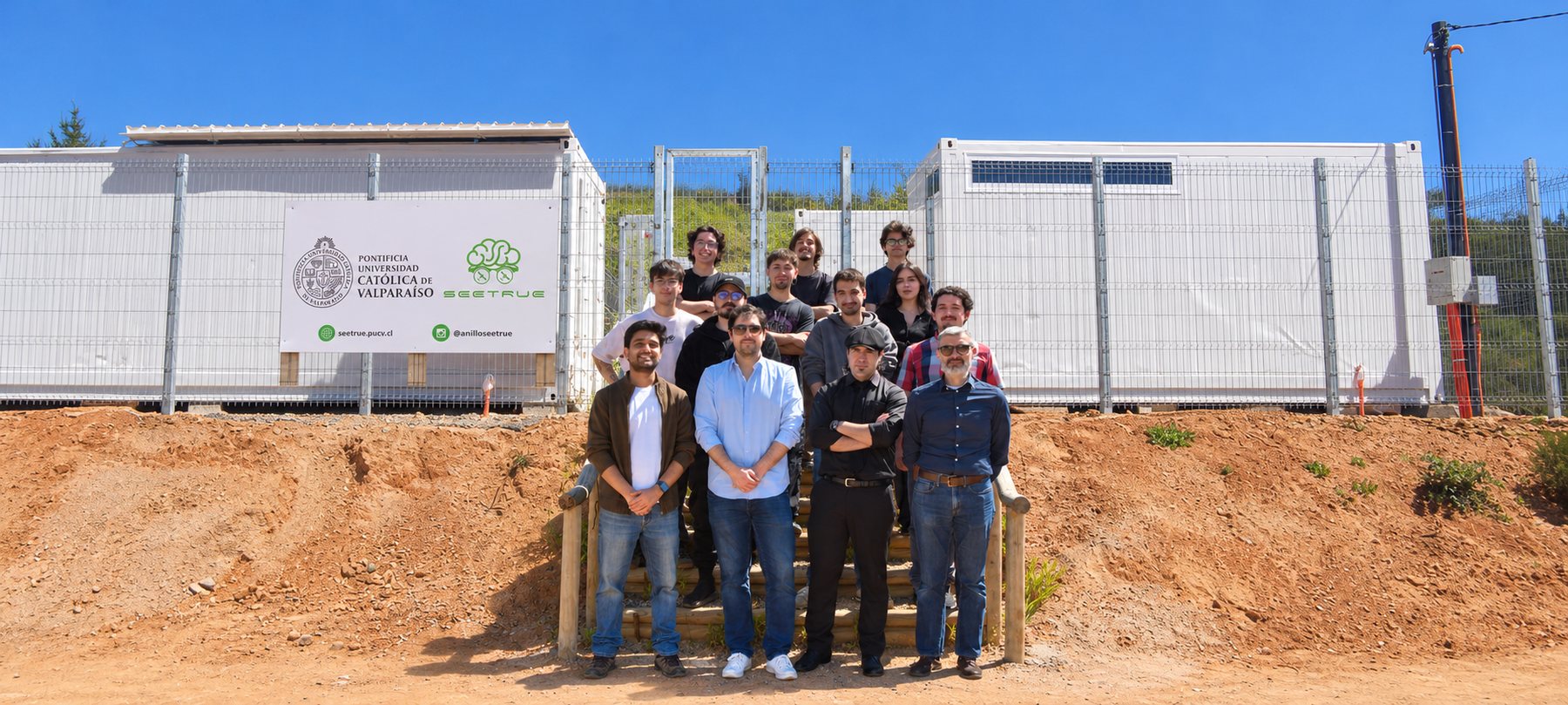
Estación óptica terrestre SEETRUESEETRUE optical ground station
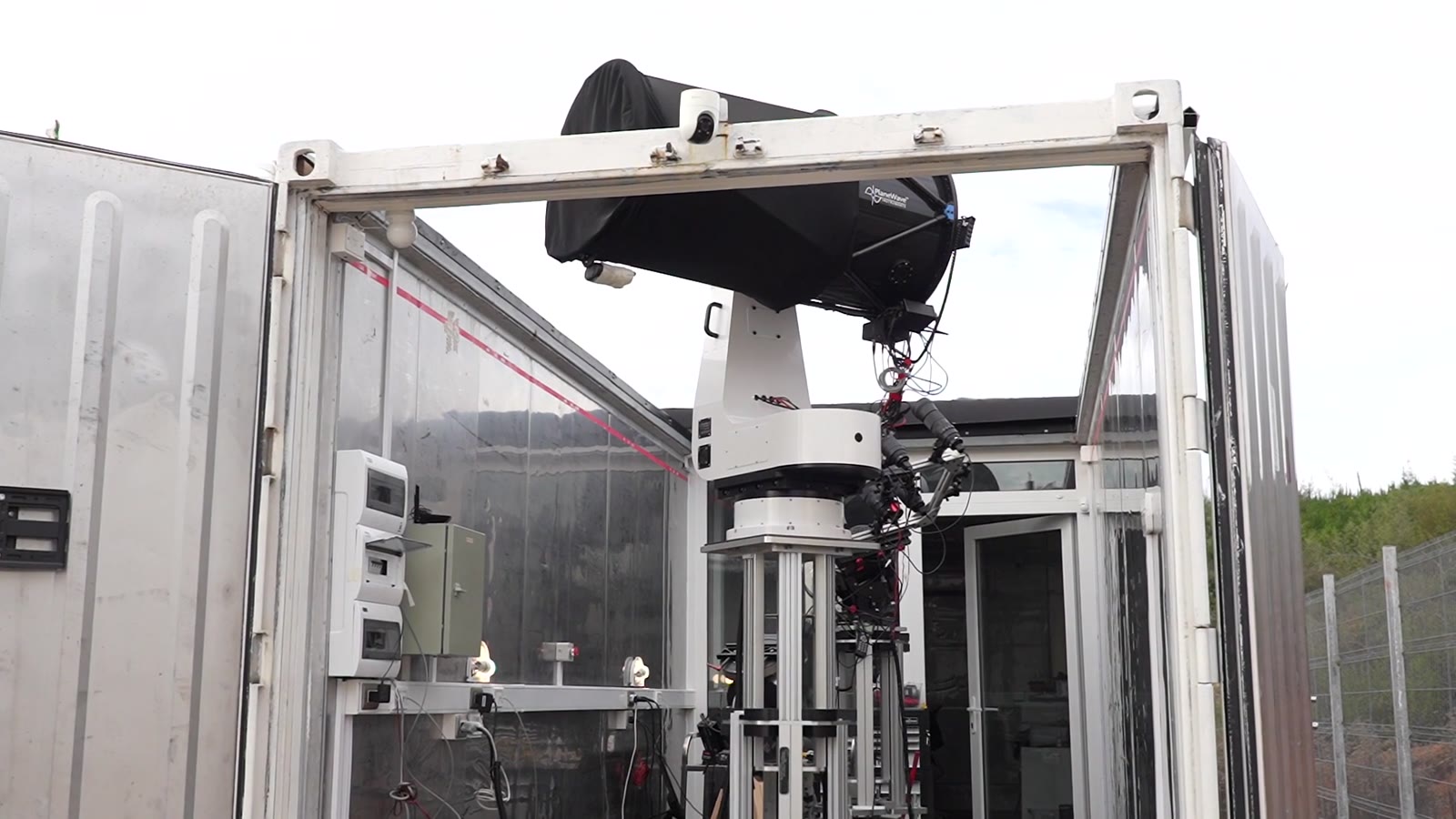
SEETRUE es la primera estación óptica terrestre de Chile financiada con fondos públicos. Se instaló en mayo de 2024 en el campus Curauma (Placilla) y se inauguró en octubre de ese año. Desde ella observamos un enlace de 55 km hasta Cerro El Roble, donde un retrorreflector y LEDs de alta potencia sirven de fuentes: unos 43 km sobre terreno bajo y habitado, y luego el ascenso a la cumbre.
SEETRUE is the first publicly funded optical ground station in Chile. It was installed in May 2024 on the Curauma campus (Placilla) and inaugurated in October of that year. From it we observe a 55 km link to Cerro El Roble, where a retroreflector and high-power LEDs act as sources: some 43 km over low, inhabited terrain, then the climb to the summit.
- TelescopioTelescope
- Ritchey–Chrétien de 20″ (PlaneWave RC20) en montura robótica L-50020″ Ritchey–Chrétien (PlaneWave RC20) on a robotic L-500 mount
- CámarasCameras
- Dos telescopios EdgeHD de 14″ con cámaras de eventosTwo 14″ EdgeHD telescopes with event cameras
- MicrometeorologíaMicrometeorology
- Sistema de covarianza turbulenta IRGASON (Campbell Scientific)IRGASON eddy-covariance system (Campbell Scientific)
- AmpliaciónExpansion
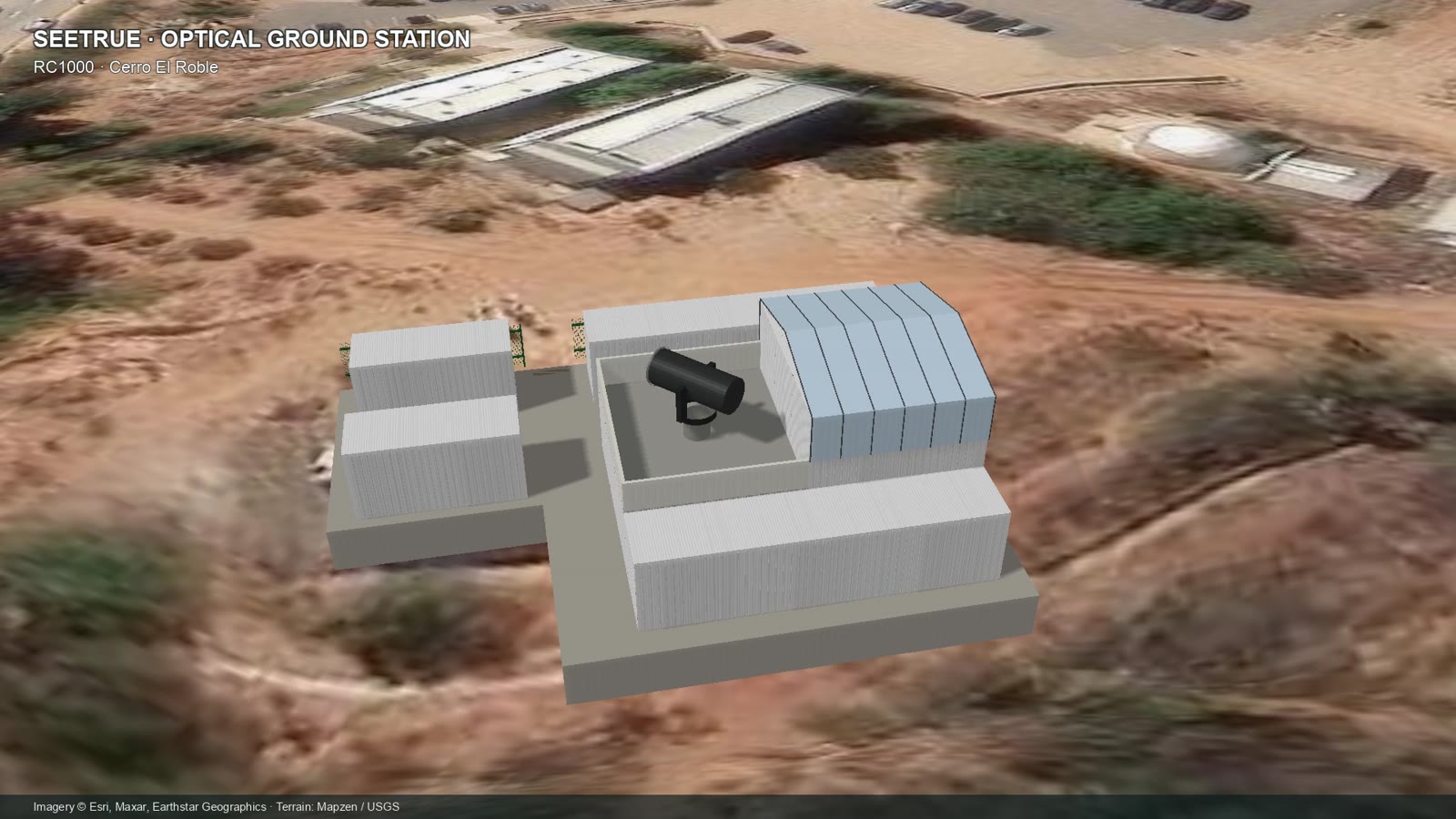
- Telescopio de 1 m (RC1000) apuntado a Cerro El Roble, FONDEQUIP EQY2400381 m telescope (RC1000) aimed at Cerro El Roble, FONDEQUIP EQY240038
Capítulo IIIChapter III
El jardín de senderos que se bifurcanThe Garden of Forking Paths
qué investigowhat I researchΦn(κ) = 0.033 Cn2 κ−11/3 El espectro de Kolmogorov, punto de partida y de discusión. The Kolmogorov spectrum: where we start, and what we question.
Capítulo IVChapter IV
El hacedorThe Maker
proyectosprojects24 proyectos: 2 Anillos ANID, 1 FONDEF, 9 FONDECYT, 2 proyectos ANID de Astronomía y 5 proyectos bilaterales. 24 projects: 2 ANID Anillos, 1 FONDEF, 9 FONDECYT, 2 ANID Astronomy projects and 5 bilateral projects.
Grandes proyectosMajor projects
Development of an autonomous real-time machine learning system for optical tomography dome turbulence assessment in the ELT
 SEETRUE
Sharp wavefront sensing for adaptive optics in ground-based satellite communications and space surveillance
 FONDEQUIP
Telescopio de 1 m (RC1000) para la estación SEETRUE, apuntado a Cerro El Roble1 m telescope (RC1000) for the SEETRUE station, aimed at Cerro El Roble
ProyectosProjects
- 2026–2028Development of an autonomous real-time machine learning system for optical tomography dome turbulence assessment in the ELT.FONDEF IDeA I+D ID26I10339 (ANID) · Director
- 2025–2028QOMMTRUE — Smart Adaptive Optics for Quantum and Classical Communications through the Atmosphere.Anillo ATE250061 (ANID) · Director alternoDeputy Director
- 2023–2025Time-lapse Imagery with a Differential stereoscope for Evapotranspiration measurementS (TIDES).ECOS ANID ECOS220012 · Investigador Responsable (contraparte chilena); contraparte francesa: R. BarilléPrincipal Investigator (Chilean counterpart); French counterpart: R. Barillé
- 2023–2024Postdoc position for the development of real-time dome turbulence assessment at Giant Segmented Mirror Telescopes.Fondo ALMA 31220004 (ANID) · Investigador ResponsablePrincipal Investigator
- 2022–2025SEETRUE — Sharp wavefront sensing for adaptive optics in ground-based satellite communications and space surveillance.Anillo ATE220022 (ANID) · Director alterno; director: E. VeraDeputy Director; Director: E. Vera
- 2021–2024Real-time dome turbulence characterization through image motion and scintillation of passive targets.FONDECYT Regular 1211848 (ANID) · Investigador ResponsablePrincipal Investigator
- 2020–2021Center for Adaptive Optics of Valparaíso (CAOVa).QUIMAL 190002 · SubdirectorDeputy Director
- 2018–2021Measurements of atmospheric turbulence for the evapotranspiration estimation by optical metrology (AE-SOP).ECOS170012 (ECOS/ANID) · Investigador Responsable (Chile)Principal Investigator (Chile)
- 2017–2019Spatio-temporal analysis of an optical chaotic signal propagating through atmospheric turbulence.FONDECYT Postdoctoral 3170533 · Investigador Patrocinante; investigador responsable: F. OlivaresSponsoring Investigator; Principal Investigator: F. Olivares
- 2014–2017Beyond the Taylor's frozen turbulence hypothesis.FONDECYT Regular 1140917 (CONICYT) · Investigador ResponsablePrincipal Investigator
- 2014–2015Caracterizando la propagación láser en medios turbulentos mediante quasi-wavelets.Programa de Cooperación Científica InternacionalInternational Scientific Cooperation Programme CONICYT/MINCyT, PCCI130029 · Investigador Responsable (contraparte chilena)Principal Investigator (Chilean counterpart)
- 2013–2015Técnicas robustas de reconstrucción de frentes de onda a partir de la estructura tridimensional de distribuciones de speckle.FONDECYT Postdoctoral 3130433 (CONICYT) · Investigador Patrocinante; investigador responsable: E. F. MossoSponsoring Investigator; Principal Investigator: E. F. Mosso
- 2010–2013Wavefront coherence degradation induced by non-Kolmogorov turbulence: multifractal analysis and models.FONDECYT Regular 1100753 (CONICYT) · Investigador ResponsablePrincipal Investigator
- 2010–2012Stock structure of the southern blue whiting Micromesistius australis: contrasting moiré topography, volume speckle field, shape analysis, and micro-structure of otoliths.FONDECYT Regular 1100895 (CONICYT) · Co-investigadorCo-investigator
- 2006–2008Multi-fractal models for wave-front aberrations from light propagating through turbulent media.FONDECYT Iniciación 11060512 · Investigador ResponsablePrincipal Investigator
Capítulo VChapter V
Del rigor en la cienciaOn Exactitude in Science
publicacionespublicationsGoogle Académico: 2.583 citas · índice h 23 · índice i10 32 (noviembre de 2026) Google Scholar: 2,583 citations · h-index 23 · i10-index 32 (November 2026)
- 202654P. Garrido, M. Sepúlveda, E. González, and D. G. Pérez, “Neuromorphic cameras as event-driven scintillometers for boundary-layer turbulence characterization,” J. Opt. Soc. Am. A 43(7), C45–C51 (2026).
- 53A. Martín Fernández Álvarez, H. Leblond, D. G. Pérez, P. Roy, and R. Barillé, “Supercontinuum laser beam propagation in free space through atmospheric turbulence,” J. Opt. Soc. Am. A 43(7), 1046–1052 (2026).
- 52I. R. Roa González, D. G. Pérez, H. Farfán, A. M. S. Macêdo, and G. L. Vasconcelos, “Analysis of non-Gaussian wandering fluctuations on multi-point targets imaging through controlled heterogeneous turbulence,” Opt. Laser Technol. 200, 115079 (2026).
- 51P. Scherz, E. Peters, N. Díaz, J. Tapia, B. Romero, E. Vera, and D. G. Pérez, “High-resolution spatiotemporal reconstruction of complex optical fields enables direct testing of turbulence statistics,” Sci. Rep. 16, 29751 (2026).
- 202550B. Romero, N. Díaz, A. Cofré, P. Scherz, J. Tapia, E. Peters, E. Vera, and D. G. Pérez, “Phase retrieval by designed Hadamard complementary coded apertures,” Opt. Laser Technol. 191, 113311 (2025).
- 202449R. Barillé, A. Korbut, S. Zielinska, E. Ortyl, and D. G. Pérez, “Laser beam shaping using a photoinduced azopolymer droplet-based mask,” Appl. Opt. 63, 990–998 (2024).
- 48S. Avramov-Zamurovic, J. Bos, M. Beason, Y. Ata, A. Muschinski, and D. Pérez, “Propagation through and characterization of atmospheric and oceanic phenomena: introduction to the joint feature issue in Applied Optics and Journal of the Optical Society of America A,” J. Opt. Soc. Am. A 41, PCA1 (2024).
- 47D. G. Pérez, H. Farfán-Bachiloglu, and M. Sepúlveda, “Spatiotemporal statistics of optical turbulence beyond Taylor's frozen turbulence hypothesis,” J. Opt. Soc. Am. A 41, B135 (2024).
- 202346G. S. Wiederhecker, S. B. Cavalcanti, A. Fontes, J. Garcia-Sucerquia, D. Perez, E. Vera, A. Bragas, C. de Matos, A. Fainstein, D. Felinto, D. M. B. P. Milori, and S. P. Walborn, “Optics in South America: introduction,” J. Opt. Soc. Am. A 40(1), OSA1 (2023).
- 45L. Núñez, R. Barillé, and D. Pérez, "Color mixing in targets seen through turbulence," J Opt 25, 024002 (2023).
- 202144F. Olivares, G. Funes, and D. G. Perez, "High frequency multifractality in return intervals from fading induced by turbulence," Fractals 29, 2150049 (2021).
- 202043F. Olivares, M. Zanin, L. Zunino, and D. G. Pérez, “Contrasting chaotic with stochastic dynamics via ordinal transition networks,” Chaos An Interdiscip. J. Nonlinear Sci. 30(6), 063101 (2020) doi:10.1063/1.5142500.
- 201942F. Olivares, L. Zunino, and D. G. Pérez, “Revisiting the decay of missing ordinal patterns in long-term correlated time series,” Phys. A Stat. Mech. its Appl. 534, 122100 (2019) doi:10.1016/j.physa.2019.122100.
- 41F. Olivares, G. Funes, and D. G. Pérez, “Turbulence-induced power drops as extreme events,” Opt. Lasers Eng. 116, 111–115 (2019) doi:10.1016/j.optlaseng.2019.01.003.
- 40F. Olivares, L. Zunino, M. C. Soriano, and D. G. Pérez, “Unraveling the decay of the number of unobserved ordinal patterns in noisy chaotic dynamics,” Phys. Rev. E 100(4), 042215 (2019) doi:10.1103/PhysRevE.100.042215.
- 201739F. Olivares, L. Zunino, D. Gulich, D. G. Pérez, and O. A. Rosso, “Multiscale permutation entropy analysis of laser beam wandering in isotropic turbulence,” Phys. Rev. E 96(4), 042207 (2017) doi:10.1103/PhysRevE.96.042207.
- 38E. Peters, P. Clemente, E. Salvador-Balaguer, E. Tajahuerce, P. Andrés, D. G. Pérez, and J. Lancis, “Real-time acquisition of complex optical fields by binary amplitude modulation,” Opt. Lett. 42(10), 2030 (2017) doi:10.1364/OL.42.002030.
- 201637A. Poisson, A. Fernandez, D. G. Perez, R. Barille, and J.-C. Dupont, “Thin laser beam wandering and intensity fluctuations method for evapotranspiration measurement,” Opt. Laser Technol. 80, 33–40 (2016) doi:10.1016/j.optlastec.2015.12.017.
- 36E. F. Mosso, N. Bolognini, and D. G. Pérez, “Single-random phase encoding architecture using a focus tunable lens,” J. Opt. 18(2), 025701 (2016) doi:10.1088/2040-8978/18/2/025701.
- 35G. Funes, F. Olivares, C. G. Weinberger, Y. D. Carrasco, L. Nuñez, and D. G. Pérez, “Synthesis of anisotropic optical turbulence at the laboratory,” Opt. Lett. 41(24), 5696 (2016) doi:10.1364/OL.41.005696.
- 201534D. G. Pérez and G. Funes, “On a quasi-wavelet model of refractive index fluctuations due to atmospheric turbulence,” Opt. Express 23(25), 31627 (2015) doi:10.1364/OE.23.031627.
- 33D. Gulich, G. Funes, D. Pérez, and L. Zunino, “Estimation of Cn2 based on scintillation of fixed targets imaged through atmospheric turbulence,” Opt. Lett. 40(23), 5642 (2015) doi:10.1364/OL.40.005642.
- 32F. Mosso, N. Bolognini, and D. G. Pérez, “Experimental optical encryption system based on a single-lens imaging architecture combined with a phase retrieval algorithm,” J. Opt. 17(6), 065702 (2015) doi:10.1088/2040-8978/17/6/065702.
- 31L. Zunino, D. Gulich, G. Funes, and D. G. Pérez, “Turbulence-induced persistence in laser beam wandering,” Opt. Lett. 40(13), 3145 (2015) doi:10.1364/OL.40.003145.
- 30F. Mosso, E. Peters, and D. G. Pérez, “Complex wavefront reconstruction from multiple-image planes produced by a focus tunable lens,” Opt. Lett. 40(20), 4623 (2015) doi:10.1364/OL.40.004623.
- 201429D. G. Pérez, R. Barillé, Y. Morille, S. Zielińska, and E. Ortyl, “Multifractal characteristics of optical turbulence measured through a single beam holographic process,” Opt. Express 22(16), 19538–19545 (2014) doi:10.1364/OE.22.019538.
- 201328F. Mosso, E. Peters, N. Bolognini, M. Tebaldi, R. Torroba, and D. G. Pérez, “Experimental imaging coding system using three-dimensional subjective speckle structures,” J. Opt. 15(12), 125403 (2013) doi:10.1088/2040-8978/15/12/125403.
- 27R. Barillé, D. G. Pérez, Y. Morille, S. Zielińska, and E. Ortyl, “Simple turbulence measurements with azopolymer thin films,” Opt. Lett. 38(7), 1128–1130 (2013).
- 26J. Leguá, G. Plaza, D. Pérez, and A. Arkhipkin, “Otolith shape analysis as a tool for stock identification of the southern blue whiting, Micromesistius australis,” Lat. Am. J. Aquat. Res. 41(3), 479 (2013) doi:103856/vol41-issue3-fulltext-11.
- 25G. Funes, Á. Fernández, D. G. Pérez, L. Zunino, and E. Serrano, “Estimating the optimal sampling rate using wavelet transform: an application to optical turbulence,” Opt. Express 21(13), 15230 (2013) doi:10.1364/OE.21.015230.
- 201224D. G. Pérez and G. Funes, “Beam wandering statistics of twin thin laser beam propagation under generalized atmospheric conditions,” Opt. Express 20(25), 27766 (2012) doi:10.1364/OE.20.027766.
- 201123L. Zunino, B. M. Tabak, F. Serinaldi, M. Zanin, D. G. Pérez, and O. A. Rosso, “Commodity predictability analysis with a permutation information theory approach,” Phys. A Stat. Mech. its Appl. 390(5), 876–890 (2011) doi:10.1016/j.physa.2010.11.020.
- 201022L. Zunino, M. Zanin, B. M. Tabak, D. G. Pérez, and O. A. Rosso, “Complexity-entropy causality plane: A useful approach to quantify the stock market inefficiency” (2010) doi:10.1016/j.physa.2010.01.007.
- 200921L. Zunino, M. C. Soriano, A. Figliola, D. G. Pérez, M. Garavaglia, C. R. Mirasso, and O. A. Rosso, “Performance of encryption schemes in chaotic optical communication: A multifractal approach” (2009) doi:10.1016/j.optcom.2009.08.047.
- 20L. Zunino, A. Figliola, B. M. Tabake, D. G. Perez, M. Garavaglia, and O. A. Rosso, “Multifractal structure in Latin-American market indices,” Chaos, Solitons & Fractals 41(5), 2331–2340 (2009).
- 19L. Zunino, M. Zanin, B. M. Tabak, D. G. Perez, and O. A. Rosso, “Forbidden patterns, permutation entropy and stock market inefficiency,” Physica A 388, 2854–2864 (2009).
- 200818L. Zunino, D. G. Pérez, A. Kowalski, M. T. Martín, M. Garavaglia, A. Plastino, and O. A. Rosso, “Fractional Brownian motion, fractional Gaussian noise, and Tsallis permutation entropy” (2008) doi:10.1016/j.physa.2008.07.004.
- 17D. G. Pérez and L. Zunino, “Generalized wave-front phase for non-Kolmogorov turbulence,” Opt. Lett. 33(6), 572–574 (2008).
- 16L. Zunino, D. G. Pérez, M. T. Martín, M. Garavaglia, A. Plastino, and O. A. Rosso, “Permutation entropy of fractional Brownian motion and fractional Gaussian noise” (2008) doi:10.1016/j.physleta.2008.05.026.
- 15L. Zunino, B. M. Tabak, A. Figliola, D. G. Pérez, M. Garavaglia, and O. A. Rosso, “A multifractal approach for stock market inefficiency” (2008) doi:10.1016/j.physa.2008.08.028.
- 200714L. Zunino, B. M. Tabak, D. G. Perez, M. Garavaglia, and O. A. Rosso, “Inefficiency in Latin-American market indices,” Eur. Phys. J. B 60(1), 111–121 (2007).
- 13L. Zunino, D. G. Pérez, M. T. Martín, A. Plastino, M. Garavaglia, and O. A. Rosso, “Characterization of Gaussian self-similar stochastic processes using wavelet-based informational tools” (2007) Phys. Rev. E 75, 021115 doi:10.1103/PhysRevE.75.021115.
- 12D. G. Pérez, L. Zunino, M. T. Martín, M. Garavaglia, A. Plastino, and O. A. Rosso, “Model-free stochastic processes studied with q-wavelet-based informational tools,” Phys. Lett. A 364(3--4), 259–266 (2007).
- 11D. D. Gulich, G. Funes, L. Zunino, D. G. Pérez, and M. Garavaglia, “Angle-of-arrival variance’s dependence on the aperture size for indoor convective turbulence,” Opt. Comm. 277, 241–246 (2007).
- 10O. A. Rosso, L. Zunino, D. G. Pérez, A. Figliola, H. A. Larrondo, M. Garavaglia, M. T. Martín, and A. Plastino, “Extracting features of Gaussian self-similar stochastic processes via the Bandt-Pompe approach” Phys. Rev. E 76, 061114 (2007) doi:10.1103/PhysRevE.76.061114.
- 9G. Funes, D. D. Gulich, L. Zunino, D. G. Pérez, M. Garavaglia, and D. G. Pérez, “Behavior of the laser beam wandering variance with the turbulent path length,” Opt. Comm. 272(2), 476–479 (2007).
- 8L. Zunino, D. G. Pérez, M. Garavaglia, and O. A. Rosso, “Wavelet entropy of stochastic processes” (2007) doi:10.1016/j.physa.2006.12.057.
- 20067D. G. Pérez, L. Zunino, M. Garavaglia, and O. A. Rosso, “Wavelet entropy and fractional Brownian motion time series,” Physica A 365, 282–288 (2006) doi:10.1016/j.physa.2005.09.060.
- 6L. Zunino, D. G. Pérez, M. Garavaglia, and O. A. Rosso, “Characterization of laser propagation through turbulent media by quantifiers based on the wavelet transform: Dynamic study” (2006) doi:10.1016/j.physa.2005.09.054.
- 20045M. Garavaglia, D. G. Pérez, and L. Zunino, “A fractional Brownian motion model for turbulent wave-front phase,” 2004 Asia-Pacific Radio Sci. Conf. - Proc. (2004).
- 4L. Zunino, D. G. Pérez, M. Garavaglia, and O. A. Rosso, “Characterization of laser propagation through turbulent media by quantifiers based on the wavelet transform” (2004) doi:10.1142/S0218348X04002471.
- 3D. G. Pérez, L. Zunino, and M. Garavaglia, “Modeling turbulent wave-front phase as a fractional Brownian motion: a new approach,” J. Opt. Soc. Am. A 21(10), 1962 (2004) doi:10.1364/JOSAA.21.001962.
- 2D. G. Pérez, L. Zunino, M. Garavaglia, and D. G. Pérez, “A fractional Brownian motion model for the turbulent refractive index in lightwave propagation,” Opt. Comm. 242, 57–63 (2004) doi:10.1016/j.optcom.2004.08.007.
- 19991D. G. Pérez and M. Garavaglia, “Intensity distribution behavior of self-image systems into turbulent media,” J. Opt. Soc. Am. A 16(4), 916 (1999) doi:10.1364/JOSAA.16.000916.
Capítulo VIChapter VI
Siete nochesSeven Nights
lo que enseñowhat I teach- Óptica y OndasOptics and Waves, fis1329
- Física en la Ciencia FicciónPhysics in Science Fiction, fis032
Capítulo VIIChapter VII
Otras inquisicionesOther Inquisitions
ensayosessaysEssays written in Spanish.
Sobre la universidad y la cienciaOn the university and science
- Pensando en una estrategia digital [para la PUCV] (2012)
- La vocación en el corazón de la formación universitaria (2013)
- La Física (2014)
- Enseñar Física (2015)
- El Futuro y Nosotros (2020)
- Los niños (no) están bien (2022)
PersonalesPersonal
- Los 4 años de nuestros mellizos (2019)
- Gigante (2022)
Capítulo VIIIChapter VIII
’39’39
qué me motivawhat drives meCiencia ficción y conocimiento científicoScience fiction and scientific knowledge
Ciencia (Ficción) · Medium Science and Science Fiction share more than a word. This publication tries to untangle their historical interconnections // Ciencia y Ciencia Ficción comparten mucho más que una simple palabra. Esta publicación trata de desentrañar sus interconexiones históricas. medium.com/science-and-fictionDivulgaciónScience outreach
Física|Mente · podcast En Física|Mente exploramos las intersecciones íntimas entre el desarrollo científico y las motivaciones personales que impulsan a quienes construyen nuestro entendimiento del universo físico. Conversaciones con colegas del Instituto de Física sobre la física moderna y sus desafíos.Física|Mente explores the intimate intersections between scientific progress and the personal motivations of those who build our understanding of the physical universe. Conversations with colleagues from the Institute of Physics on modern physics and its challenges (in Spanish). fis.ucv.cl/fisicamenteTambién enAlso on Apple Podcasts · Spotify
Ciencia colaborativaCollaborative science
#EclipseConCiencia en Chile fue nuestra primera incursión en la planificación y ejecución de un experimento colaborativo. Este pretendía aprovechar el eclipse del 14 de diciembre de 2020 para convertir a cualquier poblador de las regiones de Los Ríos y La Araucanía de meros observadores pasivos en participantes activos de un experimento científico (fue dirigido particularmente a aquellos con interés en la Astronomía, Ingeniería y Física). Bajo ciertas condiciones controladas (que se indicaron en nuestra página web), estos participantes recolectarían datos valiosos sobre un fenómeno muy interesante pero increíblemente poco entendido que ocurre en nuestra propia atmósfera a baja altura —llamado coloquialmente como Cintas de Sombras.
La turbulencia a baja altura afectará el diseño y funcionamiento de los grandes telescopios, como el Extremely Large Telescope (ELT), y actualmente centra la atención de muchos científicos del área. Es, en general, sumamente difícil de caracterizar, pero el eclipse del 14 de diciembre ofrecía una oportunidad única de avanzar en esa dirección y aportar al desarrollo científico del país.
#EclipseConCiencia in Chile was our first venture into planning and running a collaborative experiment. It set out to use the eclipse of 14 December 2020 to turn anyone living in the Los Ríos and La Araucanía regions from passive onlookers into active participants in a scientific experiment (it was aimed particularly at people interested in astronomy, engineering and physics). Under controlled conditions, described on our website, participants would collect valuable data on a fascinating yet remarkably poorly understood phenomenon of our own low atmosphere, colloquially known as shadow bands.
Low-altitude turbulence will affect the design and operation of the giant telescopes, such as the Extremely Large Telescope (ELT), and currently draws the attention of many scientists in the field. It is, in general, very hard to characterise, but the eclipse of 14 December offered a unique chance to make progress and contribute to the country's scientific development.